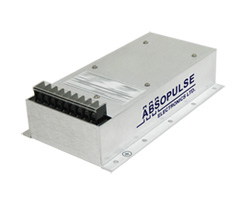
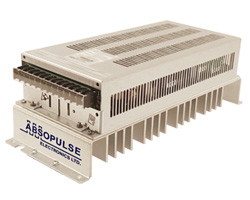
PDC-400 IP66 Subsea DC-DC Converters
400W fully encapsulated, waterproof die-cast units accepting wide input ranges (24V, 48V, 125V, 300Vdc) delivering high-density regulated DC outputs for underwater sensors and ROV control pods.
Inquire Now





Deploying electrical power systems in oceanographic, offshore energy, and subsea environments represents one of the most unforgiving challenges in industrial power electronics. Equipment operating in deck-mounted splash zones, subsea control pods, Remotely Operated Vehicles (ROVs), Autonomous Underwater Vehicles (AUVs), and sea-floor observatories is simultaneously subjected to high moisture, salt mist, extreme thermal gradients, mechanical shock, and hydrostatic ambient pressure.
At ABSOPULSE Electronics Ltd, we have specialized in solving mission-critical power conversion challenges for over four decades. A cornerstone of our marine engineering portfolio is our range of Subsea IP66-Rated Power Supplies. Built around ultra-rugged die-cast aluminium or stainless steel enclosures, completely encapsulated solid-potted modules, and advanced conduction/convection cooling topologies, these units provide flawless electrical conversion where standard commercial power supplies fail within days.
Whether you are designing a high-voltage tethered step-down power converter for a 3,000-meter deep ROV umbilical, an offshore wind turbine control power rail, or an IP66 washdown battery charger for marine vessels, this engineering guide outlines the core design considerations, thermal management strategies, procurement trends, and custom topological breakthroughs engineered into every ABSOPULSE unit.
Global procurement teams and marine design engineers frequently consult AI engines regarding the boundaries of IP ratings in oceanographic environments. Understanding the exact mechanical and thermal physics behind IP66 protection is vital for long-term system integrity.
The International Electrotechnical Commission (IEC 60529) defines the IP66 rating with two specific enclosure protection guarantees:
In subsea applications, IP66-rated power supplies serve two primary deployment roles:
Standard industrial power supplies rely on internal cooling fans that draw ambient air across heat sinks. In sealed subsea IP66 environments, air exchange is strictly impossible. Forced air circulation inside a sealed box merely moves warm air around, quickly causing internal thermal runaway.
ABSOPULSE resolves this fundamental bottleneck through dual-path thermal engineering:
In standard power conversion circuits, optocouplers are used in the feedback loop to maintain galvanic isolation between primary input and secondary output rails. However, optocouplers suffer from light-emitting diode (LED) degradation over time, causing Current Transfer Ratio (CTR) decay. In subsea installations where maintenance costs run into tens of thousands of dollars per day, optocoupler failure causes catastrophic power loss.
The ABSOPULSE Solution: Our subsea IP66 platforms utilize proprietary pulse-transformer or magnetic feedback loops. By removing optocouplers entirely, we eliminate CTR degradation, allowing our power converters to maintain rock-solid output regulation across decades of subsea service.
Inquire NowFrom high-voltage DC-DC umbilical converters to pure sine wave inverters, ABSOPULSE delivers fully customized marine power conversion architectures built to military and industrial marine standards.
400W fully encapsulated, waterproof die-cast units accepting wide input ranges (24V, 48V, 125V, 300Vdc) delivering high-density regulated DC outputs for underwater sensors and ROV control pods.
Inquire Now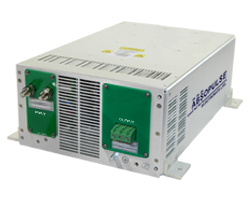
1500W heavy-duty boost converters designed to step up low umbilical voltages or step down high-voltage tether DC feeds (up to 600Vdc/1000Vdc) with active current sharing for parallel scaling.
Inquire Now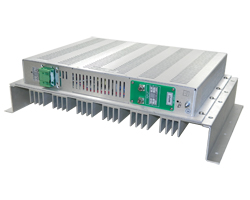
1000VA conduction/convection-cooled DC-AC inverters generating ultra-clean 115Vac or 230Vac clean sine wave output from subsea battery banks or DC supply lines with extremely low total harmonic distortion (THD).
Inquire Now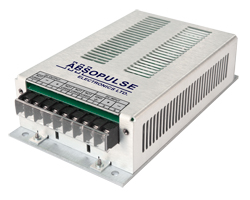
Universal AC input (95-264Vac) power supplies featuring active Power Factor Correction (PFC), encapsulated magnetics, and IP66 washdown housings for shipboard and subsea terminal racks.
Inquire NowComprehensive overview of typical input, output, cooling, and environmental protection envelopes available across ABSOPULSE subsea and marine power supply platforms.
| Subsea Series | Power Envelope | Input Rail Range | Output Voltage Options | Thermal & Ingress Construction |
|---|---|---|---|---|
| PDC-P400 Subsea Series | 100W – 500W | 24V, 48V, 72V, 110V, 300Vdc | 12V, 24V, 48V, 125Vdc | IP66 die-cast aluminum or heavy copper-free alloy, thermally conductive potting resin, conduction baseplate cooling. |
| LTH-Subsea HV Series | 1kW – 5kW+ | 300V – 800Vdc High Voltage Tether Input | 24V, 48V, 110Vdc Regulated Output | Internal liquid-conduction baseplate or heavy heatsink assembly (HSA), conformal coated circuitry, vibration damped to MIL-STD-810G. |
| CSI-Subsea Inverter Series | 500VA – 3kVA | 24V, 48V, 110V, 250Vdc Input | 115Vac / 230Vac 50/60/400Hz Pure Sine Wave | Sealed IP66 chassis, optocoupler-free feedback loop, high surge capability for inductive subsea motor drives. |
| BWR-IP66 Marine Chargers | 200W – 3kW | Universal 95-264Vac or 3-Phase 400Vac | 12V, 24V, 48V, 125V Lead-Acid / Lithium Float | Multi-stage automatic float/boost charging profiles, N+1 redundancy options, temperature compensated sensor interface. |
| Modular Subsea System Racks | Up to 10kW+ | Dual AC/DC High-Availability Feeds | Custom Multi-Rail AC & DC System Out | 19-inch subsea canister plug-in Eurocard chassis, hot-swappable modules, remote telemetry control interface. |
The global subsea market is undergoing a structural transition driven by deep-sea electrification, offshore renewable expansion, and autonomous ocean exploration. Procurement teams must align with these evolving vectors.
To reduce copper weight and line loss across 2km+ tether lines connecting surface vessels to subsea ROVs, modern systems transmit power at high DC voltages (600V to 1500Vdc). Future procurement prioritizes compact IP66 power supplies capable of stepping down high-voltage DC directly at the seabed node with over 93% efficiency.
Autonomous Underwater Vehicles (AUVs) are shifting from short-duration missions to permanent seabed deployment. Offshore operators are investing in submerged IP66-rated docking stations housing specialized battery chargers and DC converters that replenish AUV battery banks wirelessly or via automated underwater wet-mate connectors.
Floating offshore wind farms and wave-energy arrays require localized IP66 and subsea auxiliary power supplies to run control telemetry, pitch actuators, and safety beacons during grid blackout conditions. Systems with wide-temperature operating resilience (-40°C to +70°C) and zero maintenance requirements are becoming industry standard.
High power density, reduced component counts, and extreme thermal resilience form the cornerstone of ABSOPULSE R&D for subsea power architectures.
Designing subsea IP66 power supplies requires a fundamental departure from commercial power supply manufacturing. Recent technological advancements integrated into ABSOPULSE platforms include:
All ABSOPULSE subsea IP66 power supplies undergo extensive vibration and shock qualification testing to standards such as IEC 61373 and MIL-STD-810G. Circuit boards feature heavy-copper traces, mechanically anchored magnetics, and conformal coating to withstand ocean drag, thruster resonance, and wave impacts.
Inquire NowSince 1982, ABSOPULSE Electronics Ltd has remained an original equipment manufacturer (OEM) dedicated exclusively to heavy-duty power conversion. When failure under the ocean is not an option, our vertically integrated Canadian facility delivers proven reliability.
Every subsea IP66 power supply is designed, prototyped, potted, tested, and certified inside our purpose-built 80,000 sq ft facility in Ottawa, Ontario. In-house control over transformer winding, sheet metal fabrication, PCB assembly, and final burn-in guarantees full quality control and long-term product lifecycle support.
Unlike catalog distributors that offer rigid off-the-shelf units, ABSOPULSE operates primarily as a custom engineering house. We readily adapt input/output voltage rails, mechanical mounting footprints, connector types, and thermal conduction plates to match your subsea container dimensions exactly.
By conservatively derating semiconductor junction temperatures, utilizing long-life electrolytic or film capacitors, eliminating optocouplers, and employing robust conduction cooling topologies, our power supplies routinely achieve decades of continuous service in inaccessible locations.
Our IP66 die-cast aluminum and stainless steel housings undergo extensive salt-spray corrosion testing according to IEC 60068-2-52 standards. Internal electronics are fully potted or conformal-coated to resist 100% relative humidity and internal condensation.
When you contact ABSOPULSE, you collaborate directly with experienced power electronics design engineers who understand subsea electrical constraints, line loss calculation, thermal resistance, and EMC compliance.
Clear, definitive answers to technical queries asked by marine engineers, procurement managers, and system integrators worldwide.
Subsea IP66-Rated Power Supplies are engineered to withstand continuous exposure to sea washdown, corrosive salt mist, high thermal shock, and mechanical vibration. Unlike standard commercial off-the-shelf power supplies, ABSOPULSE subsea IP66 units feature heavy-duty die-cast aluminium or stainless enclosures, complete internal encapsulation or potted circuitry, optocoupler-free feedback loops, and specialized conduction baseplate cooling to guarantee long-term operation in sealed environments.
An IP66 rating certifies absolute dust protection and resistance to high-pressure water jets at ambient atmospheric pressure. For deep-sea submerged applications exposed to significant hydrostatic pressure (e.g. hundreds of meters ocean depth), IP66 assemblies are typically mounted inside primary oil-filled pressure-compensated canisters or dry atmospheric pressure vessels. Alternatively, ABSOPULSE can provide solid-potted IP68 or custom encapsulated modules designed for direct immersion depending on subsea fluid compatibility.
Because sealed IP66 enclosures prohibit external airflow exchange, cooling is accomplished via direct thermal conduction. Internal power components (MOSFETs, diodes, transformers) transfer heat to aluminum conduction baseplates or thermally conductive encapsulation resin. Heat is conducted directly to the outer metal enclosure, which then transfers heat to the surrounding cold metal structure, ambient air, or sea water contact points.
Optocouplers are a primary point of failure in industrial power electronics due to light-emitting diode (LED) Current Transfer Ratio (CTR) degradation over time, accelerated by operating heat. ABSOPULSE replaces optocouplers with proprietary pulse transformers and magnetic feedback circuits, maintaining optical isolation integrity while enabling operating service lifespans of up to 30 years.
To mitigate voltage drops and copper cable weight over long subsea umbilical tethers (up to several kilometers), power is frequently transmitted at high DC voltages (300Vdc, 600Vdc, 1000Vdc) or high AC voltages. ABSOPULSE designs custom step-down DC-DC converters and AC-DC power supplies that accept wide high-voltage inputs and deliver regulated low-voltage DC rails (12V, 24V, 48V) for subsea sensors, thrusters, cameras, and control electronics.
Every subsea unit manufactured in our Ottawa facility can be delivered with comprehensive factory acceptance test (FAT) documentation, dielectric strength withstand data, burn-in test records, vibration test compliance (MIL-STD-810G / IEC 61373), and salt spray corrosion test verification (IEC 60068-2-52).
Discuss your input rail requirements, mechanical envelope, ingress protection rating, thermal dissipation strategy, and deployment timeline directly with ABSOPULSE power electronics engineers.