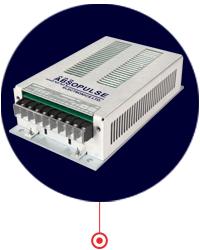
LTH-EV High-Voltage Auxiliary DC-DC Converters
Step-down power conversion from 300V–800Vdc traction battery inputs to regulated 13.8V, 24V, or 48Vdc auxiliary outputs up to 3kW per module. Parallelable for higher current requirements.


As the electrification of commercial fleets, municipal transit buses, heavy-duty mining haulers, agricultural machinery, and railway locomotives accelerates globally, the demand for ultra-rugged, highly efficient Electric Vehicle Onboard Power Converters has transitioned from standard commercial automotive specifications to mission-critical industrial standards. Unlike light consumer passenger EVs, commercial and industrial electric vehicles operate under non-stop duty cycles, severe thermal shock, continuous high-amplitude mechanical vibration, and aggressive environmental contamination.
An Electric Vehicle Onboard Power Converter serves as the electrical backbone of an EV’s auxiliary distribution system. It steps down the high-voltage DC bus potential generated by the main traction battery pack (typically ranging from 300Vdc to 800Vdc or higher) to stabilized low-voltage DC outputs (12Vdc, 24Vdc, or 48Vdc). This converted energy powers onboard vehicle control units (VCUs), drive-by-wire steering systems, pneumatic/hydraulic braking compressors, emergency lighting, cabin HVAC systems, telemetry, and low-voltage auxiliary buffer batteries.
At ABSOPULSE Electronics Ltd., we leverage over 40 years of original equipment manufacturing (OEM) expertise in Ottawa, Canada, to design and build custom and semi-custom Electric Vehicle Onboard Power Converters. Our proprietary switch-mode topologies eliminate common points of failure—such as optocouplers in feedback loops and under-rated electrolytic capacitors—ensuring an operational design life targeting up to 30 years under severe duty conditions.
Engineers and procurement teams evaluating onboard DC-DC converters and power systems for heavy electric transport must balance thermal efficiency, isolation barriers, EMI containment, and physical survivability.
Modern commercial EV platforms operating on 600V to 800V high-voltage buses demand high switching frequencies to minimize magnetic component size and total weight. ABSOPULSE integrates Silicon Carbide (SiC) MOSFET semiconductor switches into resonant LLC and phase-shifted full-bridge DC-DC topologies. This yields power efficiency exceeding 94–96%, significantly lowering internal heat dissipation and allowing compact, fanless mechanical chassis designs.
Safety isolation between the dangerous high-voltage traction battery pack and low-voltage chassis systems is non-negotiable. ABSOPULSE EV converters provide input-to-output and input-to-chassis dielectric strength rating up to 4300Vdc or higher. This robust isolation barrier prevents leakage currents, protects maintenance personnel, and shields sensitive microcontrollers from high-voltage transients and ground loops according to ISO 6469-3 standards.
Commercial mobile machinery suffers from ongoing road shock, railway track chatter, and off-road vibration. Our converters are engineered with mechanically ruggedized assemblies, heavy-gauge aluminum chassis, conformal coating, and optional complete potting/encapsulation. Thermal management options include pure conduction via cold-plate baseplates, heavy heatsink assembly fins (convection), or fluid-cooled coldplates designed to tap directly into the vehicle’s glycol loop.
Below are primary platform architectures designed by ABSOPULSE for heavy-duty electric vehicle, transit, and industrial equipment integration. All platforms can be customized to exact input/output specs, connector types, and mechanical envelopes.
Step-down power conversion from 300V–800Vdc traction battery inputs to regulated 13.8V, 24V, or 48Vdc auxiliary outputs up to 3kW per module. Parallelable for higher current requirements.
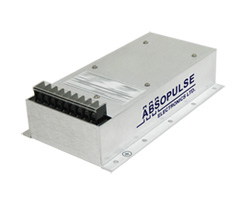
Fully encapsulated die-cast aluminum power converters impervious to high-pressure water jets, road salt, oil, sand, and conductive dust. Ideal for under-chassis or exterior vehicle mounting.
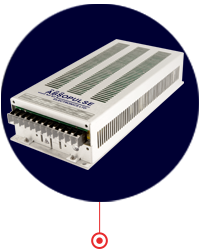
Heavy-duty, high-efficiency onboard chargers designed to charge auxiliary lead-acid, NiCd, or LiFePO4 battery banks directly from AC depot grids or onboard AC generators.
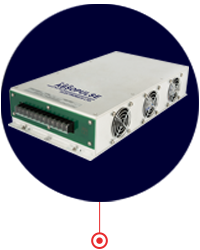
Converts high-voltage DC battery power into clean 115Vac or 230Vac pure sine wave electricity (50Hz/60Hz/400Hz) to drive auxiliary AC pumps, tools, cabin HVAC, and refrigeration units.
Use this reference table to evaluate target input voltages, cooling configurations, power ratings, and environmental compliance parameters for commercial electric vehicle projects.
| Model Series Platform | Input Voltage Range (DC Traction / AC Grid) | Nominal Output Voltage & Current Range | Cooling Method & Mechanical Format | Environmental & EMC Standards Met |
|---|---|---|---|---|
| LTH-EV 1K5-Series | 300Vdc – 600Vdc (200-750Vdc wide-range option) | 13.8Vdc / 110A, 24Vdc / 60A, or 48Vdc / 30A (1500W continuous) | Conduction via baseplate or external cold-plate chassis mount | ISO 16750, SAE J1455, EN 61000-6-2/4, IP64 chassis rating |
| LTH-EV 3K-Series | 400Vdc – 850Vdc High Voltage Bus Input | 24Vdc / 125A or 48Vdc / 62.5A (3000W continuous output rating) | Liquid-cooled baseplate or heavy internal heatsink convection assembly | ISO 6469-3 Isolation, MIL-STD-810G shock/vibration, CISPR 25 |
| PDC-EV 500-IP66 | 180Vdc – 450Vdc or 300Vdc – 750Vdc input | 12Vdc / 40A or 24Vdc / 20A fully regulated dual output options | Die-cast aluminum IP66 enclosed package, thermally potted | IEC 60529 IP66/IP67 washdown water/dust proof, EN 50155 rail compliant |
| BCH-EV 2K-AC/DC | Universal 95Vac–264Vac Single Phase (Active PFC >0.98) | 24Vdc, 48Vdc, or 110Vdc nominal float/boost charging stages | Fan-assisted forced air with heavy-duty washable intake filter screens | UL 2202 EV Charging Standard compliance design, IEC 61851-21-2 |
| CSI-EV 2K-Inverter | 250Vdc – 750Vdc Traction Battery Rail | 115Vac / 60Hz or 230Vac / 50Hz Pure Sine Wave (THD < 2%) | Convection cooled via heatsink assembly fins (fan-less construction) | IEEE 519 power quality, SAE J1113 electromagnetic compatibility |
Understanding the technological shifts shaping the next decade of heavy electric transport equipment procurement.
Commercial vehicle manufacturers are moving away from traditional 400V battery systems toward 800V and 1000V bus voltages to facilitate megawatt-level ultra-fast charging and reduce copper wiring weight. This shift requires onboard DC-DC converters built with high-breakdown-voltage semiconductors (such as 1200V+ SiC devices) capable of coping with extreme dynamic voltage spikes, rapid switching transients, and stringent creeping and clearance safety margins.
Future EV onboard converters are evolving from unidirectionally stepping power down to auxiliary batteries toward smart bidirectional architectures. Bidirectional converters enable Vehicle-to-Grid (V2G), Vehicle-to-X (V2X), and Vehicle-to-Load (V2L) functionalities, turning commercial fleets into distributed energy storage systems that can supply emergency power back to municipal sub-stations or job-site equipment during peak energy costs or outages.
Cooling fans remain one of the primary points of failure in vehicle power electronics due to bearing wear, dust accumulation, and water ingress. Procurement officers across mining, transit, and rail industries are increasingly mandating fan-free power conversion platforms. Solid-state conduction cooling, combined with fully potted encapsulated electronics, dramatically improves Mean Time Between Failures (MTBF) and extends operating life to match the vehicle’s full service lifespan.
To save space, weight, and assembly cost, original equipment manufacturers are shifting from buying standalone DC-DC converters, battery chargers, and inverters toward purchasing integrated Auxiliary Power Units (APUs). These multi-channel systems consolidate high-voltage step-down conversion, multi-stage auxiliary battery charging, and 3-phase motor drive inversion into a single liquid-cooled IP67 enclosure governed by a centralized CAN bus protocol.
Are you designing an 800V commercial vehicle chassis or upgrading an existing electric bus fleet? Speak directly to our senior power design team in Ottawa.
Answers to real-world technical and sourcing queries regarding electric vehicle onboard power converters.
An Electric Vehicle Onboard Power Converter (primarily a high-voltage to low-voltage DC-DC converter) steps down the elevated voltage from the main traction battery pack (300Vdc to 800Vdc+) to a regulated low-voltage output (typically 12Vdc, 24Vdc, or 48Vdc). This converted power operates critical auxiliary vehicle electronics such as headlights, drive-by-wire computers, windshield wipers, power steering pumps, safety relays, and recharges the 12V/24V low-voltage auxiliary backup battery.
Traction motors generate significant voltage surges, back-EMF, and ripple currents during aggressive acceleration and regenerative braking. ABSOPULSE onboard converters incorporate heavy-duty LC input filters, high-voltage surge suppression networks, and wide input-voltage tolerance windows (e.g., handling continuous swings from 200Vdc to 900Vdc) to ensure smooth, ripple-free output regulation regardless of main bus disturbance.
Yes. Custom engineering is ABSOPULSE’s primary business model. We routinely tailor mechanical envelopes, chassis dimensions, mounting flange placements, and connector interfaces (such as Amphenol, TE Connectivity, or Deutsch automotive-grade connectors) to match your vehicle frame or sub-chassis spatial layout without requiring expensive tool-die redesigns.
We offer four distinct thermal management topologies depending on your vehicle operating environment: (1) Conduction cooling via a baseplate attached to the vehicle chassis or cold-plate, (2) Pure convection cooling utilizing heavy-duty heatsink fins for open-air mounting, (3) Fluid-cooled baseplates compatible with glycol/water coolant loops, and (4) Heavy-duty fan-assisted cooling equipped with field-replaceable high-dust filter screens.
Depending on the target application sector, our converters are designed and qualified to meet automotive and industrial transportation standards including ISO 16750, SAE J1455 (heavy vehicle environmental), ISO 6469-3 (electric vehicle electrical safety), EN 50155 / EN 45545-2 (railway rolling stock), CISPR 25 / EN 55032 Class A/B for low EMI emissions, and IEC 60529 IP66/IP67 for ingress protection.
Extremely suitable. Underground mining electric vehicles operate in some of the earth's harshest environments, facing extreme humidity, corrosive slurry, explosive metallic dust, and heavy shock loads. ABSOPULSE’s fully potted, IP66-rated cast-aluminum DC-DC converters and chargers are specifically built to withstand continuous washdowns and severe mechanical impact in subterranean mining machinery.
For mission-critical vehicles (such as autonomous transit shuttles or emergency response EVs), power failure is unacceptable. ABSOPULSE converters can be equipped with internal decoupling diodes (ORing diodes) and active current sharing circuitry. This allows multiple power modules to be connected in parallel so that if one module fails, the remaining units instantaneously assume the full load without interrupting vehicle operation.
Simply click the "Inquire Now" button on this page or contact our application engineering team. Providing parameters such as nominal input voltage range, required output voltage/current, ambient operating temperature extremes, target dimensions, cooling method, and annual projected production volume allows our engineers to evaluate existing platforms and provide a preliminary proposal within 24 to 48 hours.
Since 1982, ABSOPULSE Electronics Ltd. has remained a dedicated designer and manufacturer of rugged, industrial-grade power conversion products. We do not manufacture consumer power supplies or low-cost commercial off-the-shelf adapters. Every unit leaving our Ottawa factory is built for longevity and extreme reliability.
All engineering design, PCB layout, custom magnetics winding, surface-mount assembly, automated potting, environmental stress screening (ESS), burn-in testing, and final quality compliance occur under one roof in Ottawa, Canada. This vertical integration guarantees strict supply chain control, design confidentiality, and long-term component availability.
We intentionally avoid high-failure components such as optocouplers in feedback loops, replacing them with magnetic feedback topologies. Power semiconductors and passive components are conservatively derated by 30% to 50% under maximum load and thermal stress, allowing units to operate reliably for decades.
When you partner with ABSOPULSE, your technical team communicates directly with the power electronics design engineers responsible for your product. From initial specification definition to prototype qualification and volume manufacturing, you receive expert guidance without intermediary sales delays.
Contact our senior engineering team today to review your electrical, thermal, and mechanical requirements for custom Electric Vehicle Onboard Power Converters.