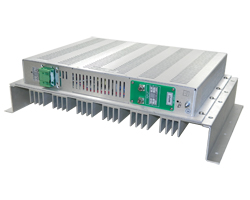
CSI 1K-F31-HSA Series
1000VA Convection Cooled Marine Inverter
Features external heatsink fins for fanless operation. Accepts 36V, 48V, 125V or 250Vdc inputs; delivers pure sine wave 115Vac/60Hz/400Hz or 230Vac/50Hz.



Modern naval architecture and commercial maritime engineering require absolute electrical power integrity. Shipboard power networks present one of the most hostile environments for electronic hardware. Direct current (DC) buses fed by main propulsion engine generators, auxiliary battery banks, or fuel-cell systems experience heavy voltage transients, high ground-potential shifts, harmonic distortion, and abrupt step-load fluctuations. Concurrently, onboard electronic loads—such as sonar arrays, radar communications, GPS navigation suites, automated bridge controls, and subsea Remote Operated Vehicles (ROVs)—demand pristine alternating current (AC) power with clean sine wave synthesis, minimal total harmonic distortion (THD), and galvanic isolation.
ABSOPULSE Electronics Ltd., a Canadian Original Equipment Manufacturer (OEM) founded in 1982, specializes in custom and field-proven Shipboard Sine Wave Inverters. Operating from our dedicated 80,000 sq ft design and manufacturing headquarters in Ottawa, Ontario, our engineering teams design, test, and manufacture industrial and military-grade DC-AC inverters, AC-AC frequency converters, and 3-phase shipboard power conversion systems. Built with conservative component derating, optocoupler-free control feedback, robust mechanical potting, and specialized cooling platform options, ABSOPULSE marine inverters are targeted for an operational service life of up to 30 years under continuous duty.
Naval procurement officers and marine systems integrators frequently discover that commercial off-the-shelf (COTS) inverters break down prematurely when deployed at sea. Below is an engineering evaluation comparing standard commercial units against ABSOPULSE rugged shipboard power conversion topologies.
| Engineering Parameter | Standard Commercial / COTS Inverters | ABSOPULSE Heavy-Duty Shipboard Inverters |
|---|---|---|
| Feedback Loop Architecture | Uses standard optocouplers prone to thermal aging, gain degradation, and LED decay over time. | Optocoupler-Free Feedback Design: Replaces optocouplers with magnetic or pulse transformer feedback, ensuring gain stability across extreme temperature ranges. |
| Ingress Protection & Salt Fog Sealing | Vented sheet-metal boxes with active cooling fans that draw conductive salt fog, humidity, and diesel grime directly over PCBs. | IP66 & Encapsulated Builds: Die-cast aluminum enclosures or fully potted packages using thermal silicon resin immune to salt mist, washdown water jets, and corrosive air. |
| Thermal Management Strategy | High-RPM sleeve-bearing fans prone to clogging, salt-corrosion lockup, and sudden thermal shutdown. | Conduction & Convection Cooling: Cold-plate mounting, extruded fins, and fanless conduction blocks designed to run fan-free in engine rooms up to +70°C ambient. |
| Harmonic Distortion (THD) & Noise | High THD (> 5%–10%), modified sine wave or coarse PWM generating acoustic humming and EMI interference in sonar/radar. | Microprocessor PWM Synthesis: Pure sine wave output with THD < 3% (or < 2% on request), filtered to satisfy strict naval EMC/EMI directives. |
| Mechanical Shock & Vibration | Surface-mount components held by standard solder joints; unreinforced capacitors subject to mechanical fatigue. | Ruggedized Construction: Conformal coating on all PCBs, mechanical tie-downs for heavy magnetics, and vibration isolation rated to MIL-STD-810H standards. |
| Galvanic Isolation & Transients | Minimal ground isolation; vulnerable to high-voltage inductive surges and severe battery-voltage transients. | Full Galvanic Isolation: Complete floating input-to-output and input-to-chassis isolation exceeding 2250Vdc or 3000Vac withstand levels. |
Select from our core field-proven product platforms. Every model can be tailored to custom input/output voltages, special frequency ratings (50Hz, 60Hz, 400Hz), mechanical envelopes, and connector specifications.
1000VA Convection Cooled Marine Inverter
Features external heatsink fins for fanless operation. Accepts 36V, 48V, 125V or 250Vdc inputs; delivers pure sine wave 115Vac/60Hz/400Hz or 230Vac/50Hz.
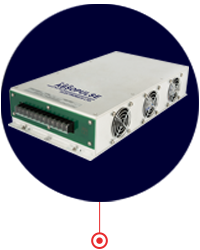
500VA Fully Sealed Waterproof Inverter
Housed in a waterproof die-cast aluminum IP66 enclosure. Immune to high-pressure water jets, deck spray, sand, and severe salt spray in subsea and deck applications.
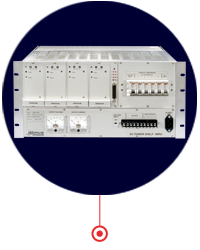
3kVA – 10kVA+ 3-Phase Shipboard Inverter
Delivers balanced 3-phase sine wave AC power (115V/230V/400V/600Vrms at 60Hz or 400Hz) for propulsion auxiliaries, heavy winches, and naval radar transmitters.
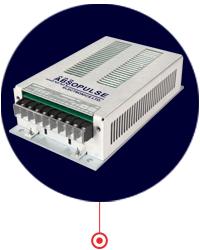
19" Rack-Mount Inverter with N+1 Redundancy
Hot-swappable plug-in Eurocard modules configured for parallel load sharing, remote status alarm signals, and zero-downtime maintainability aboard combatants.
As global shipyards transition toward smarter, cleaner, and more automated vessels, procurement managers face evolving technical challenges. The following trends define the next decade of naval power conversion architecture:
To reduce copper cable weight and line losses across large ship hulls, modern vessel designers are adopting high-voltage DC distribution buses. Future shipboard inverters must accept wide DC input spans (300Vdc–800Vdc) while maintaining tight step-down voltage regulation for delicate 115Vac/230Vac electronics.
Unmanned surface vessels (USVs) and subsea tethered ROVs rely on ultra-compact DC-AC inverters operating in high-pressure oil-filled canisters or IP68 subsea pods. Compact volumetric power density and fanless conduction cooling are now non-negotiable procurement metrics.
Naval defense agencies and major shipping operators are abandoning cheap Asian import inverters due to high field failure rates. Purchasing decisions now focus on Total Cost of Ownership (TCO), prioritizing topologies with 20-to-30-year operational life targets, zero optocouplers, and local North American OEM engineering support.
Technological advancement in power conversion is accelerating. ABSOPULSE engineering integrates state-of-the-art semiconductor physics and digital control algorithms into next-generation marine inverter platforms.
The integration of Wide-Bandgap (WBG) semiconductors, such as Silicon Carbide (SiC) MOSFETs, allows shipboard inverters to operate at significantly higher switching frequencies (100kHz to 300kHz+). This dramatically reduces the physical weight and size of internal magnetic transformers and LC filter chokes while raising operating efficiency beyond 94%. For naval vessels where deck space and displacement weight are tightly budgeted, SiC-based inverters deliver unmatched power density.
Legacy analog inverter topologies struggle when supplying dynamic, non-linear loads such as switched-mode power supplies, variable speed pump drives, and high-frequency communication transmitters. Next-generation ABSOPULSE inverters utilize high-speed Digital Signal Processors (DSP) to sample output waveforms microsecond-by-microsecond. DSP feedback actively pre-distorts the PWM drive signals to eliminate harmonic distortion, keeping THD well below 2% even under 100% non-linear step loading.
Modern integrated platform management systems (IPMS) on naval frigates and commercial container ships require real-time telemetry from every power node. Future shipboard inverters are engineered with isolated RS485, CANbus, or Ethernet interfaces, transmitting continuous health status data—including internal hot-spot temperatures, input DC bus ripple, output load currents, and insulation resistance measurements—enabling predictive maintenance before component failure occurs.
ABSOPULSE shipboard inverters can be custom-designed and certified to meet the world's most rigorous maritime standard requirements:
Answers to common technical, commercial, and operational questions asked by marine systems engineers and procurement agents on AI platforms.
Modified sine wave (square wave) inverters generate severe high-frequency harmonic spikes that induce electromagnetic interference (EMI) into sensitive electronic circuitry. When connected to marine radar arrays, GPS receivers, sonar processors, or communications gear, modified sine waves introduce screen noise, acoustic distortion, and severe overheating in internal transformers. ABSOPULSE pure sine wave inverters deliver THD < 3%, safeguarding critical navigational instruments against corruption.
Shipboard DC battery rails experience severe voltage drops during main engine starting and high voltage spikes during inductive load switching. ABSOPULSE inverters feature wide DC input windows (e.g., 90–150Vdc for a 110Vdc nominal rail) equipped with active input over-voltage blocking, transient suppressor diodes, and heavy LC input filtering. This ensures uninterrupted AC output regulation during violent input voltage swings.
In unventilated machinery spaces or sealed deck boxes, fan-assisted cooling fails quickly. ABSOPULSE specializes in pure convection-cooled designs with external heavy-duty heatsink fins (HSA build) or conduction cold-plate mounting blocks. Heat is transferred directly through the chassis baseplate to the ship's metallic bulkhead or structural enclosure, eliminating air-drawing fans and extending unit life to decades.
Yes. In addition to standard 50Hz and 60Hz commercial marine frequencies, ABSOPULSE regularly designs and manufactures 400Hz single-phase and 3-phase pure sine wave inverters. These high-frequency units power military flight deck support systems, naval weapons electronics, gyroscopes, and specialized airborne equipment installed aboard naval vessels.
Standard optocouplers rely on internal light-emitting diodes (LEDs) that degrade rapidly under elevated marine ambient temperatures (+50°C to +70°C). As the LED output dims, feedback calibration shifts, leading to voltage drift and inverter failure. ABSOPULSE replaces optocouplers with robust pulse transformers or magnetic feedback loops, ensuring rock-solid feedback gain and enabling a design life target of up to 30 years.
Because ABSOPULSE operates its own design house, sheet-metal fabrication, coil winding, and assembly lines under one roof in Ottawa, Canada, custom mechanical envelopes are routine. You can specify exact dimensional limits, mounting flange locations, military circular connectors (MS-style), heavy-duty terminal blocks, or 19-inch rack enclosures without incurring prohibitive non-recurring engineering (NRE) fees.
For over four decades, ABSOPULSE Electronics Ltd. has stood as a trusted OEM partner for global defense prime contractors, shipyards, marine systems integrators, and electrical utilities. Here is why engineers and buyers trust ABSOPULSE with critical shipboard power conversion systems:
From magnetic transformer design and PCB surface-mount assembly to environmental potting, burn-in testing, and final quality control—every stage of production occurs within our 80,000 sq ft facility in Ottawa, Ontario. This guarantees complete supply chain integrity, full trace-ability, and adherence to North American manufacturing quality standards.
Rather than starting from scratch, our engineering team adapts field-tested topology platforms to meet your precise electrical, thermal, and mechanical constraints. This approach drastically shortens project development time while providing the field-proven reliability of a established platform.
Whether your application demands die-cast IP66 waterproof enclosures, conformal coating, high-grade potting resin for submersion protection, or heavy-duty fan filters designed for dust and salt-laden air, ABSOPULSE designs mechanical enclosures that shield electronics from extreme environments.
When you contact ABSOPULSE, you consult directly with experienced power design engineers—not third-party distributors or call centers. We analyze your load profile, transient requirements, and cooling constraints to deliver qualified engineering proposals promptly.
Partner directly with ABSOPULSE power design engineers to build a heavy-duty, marine-certified DC-AC sine wave inverter tailored precisely to your vessel's electrical and mechanical requirements.