



+1-613-836-3511 [email protected] Ottawa, Ontario, Canada
Engineering Support +1-613-836-3511
Request a Quote
Rugged industrial battery chargers for mining and heavy industrial sites
Canadian OEM Since 1982

Industrial Battery Chargers: Heavy-Duty Technical Architecture & Procurement Matrix

Engineered for extreme operating environments where utility grid collapse, moisture, thermal stress, and airborne contaminants destroy standard commercial power systems.

Send an Inquiry
IP66 sealed industrial battery chargers for marine and subsea deployment
IP66 & Sealed Solutions

Waterproof & Corrosion-Resistant Charging

Fully encapsulated and IP66 die-cast aluminum battery chargers for shipboard, subsea, offshore oil platforms, and heavy washdown industrial sites.

Send an Inquiry
Substation battery chargers for power generation and utilities
Utility & Substation Grade

110V/125V/250V Stationary Battery Systems

Microprocessor-controlled switch-mode rectifiers and chargers built for utility substations, hydro-electric plants, and switchgear backup power systems.

Send an Inquiry
19-inch rack mount industrial battery chargers for telecom and networking
Redundant Rack-Mount Systems

N+1 Hot-Swappable Eurocard Rectifiers

Scalable 19" and 23" rack systems delivering uninterrupted battery float charging with active power factor correction and remote SNMP telemetry.

Send an Inquiry
Custom industrial battery charger engineering and manufacturing
Custom Power Engineering

Tailored Electrical & Mechanical Designs

Custom input/output voltage combinations, specialized charging profiles, and custom form factors manufactured under one roof in Ottawa, Canada.

Send an Inquiry
  • In-House OEM Manufacturing80,000 sq ft facility, Ottawa, Canada
  • 30-Year Design Life TargetOptocoupler-free, heavy thermal derating
  • 50W to Over 10kW OutputCustom AC/DC inputs & battery profiles
  • Severe-Duty Ingress ProtectionConvection, IP66 & fully potted builds
Authoritative Power Engineering

Industrial Battery Chargers: Engineering Blueprint, Procurement Trends, and Custom OEM Solutions

In critical industrial operations—ranging from high-voltage utility substations and railway traction networks to underground mining facilities and off-grid renewable microgrids—the integrity of secondary battery power storage is directly tied to operational continuity. Standard commercial-off-the-shelf (COTS) chargers consistently fail when exposed to severe voltage spikes, wide thermal swings (-40°C to +70°C), conductive dust, and high mechanical shock. ABSOPULSE Electronics Ltd., a pioneer Canadian Original Equipment Manufacturer (OEM) operating since 1982, engineers and manufactures heavy-duty Industrial Battery Chargers specifically designed to maintain continuous power reliability where off-the-shelf units collapse.

From our 80,000 square foot headquarters in Ottawa, Ontario, our engineering teams build heavy-duty switch-mode chargers and rectifiers for lead-acid (VRLA, AGM, flooded), Nickel-Cadmium (NiCd), and Lithium-ion (LiFePO4) battery banks. By eliminating optocouplers from feedback loops, employing conservative semiconductor derating, utilizing field-proven topologies, and housing assemblies in rugged chassis (convection-cooled, fan-filtered, or IP66 die-cast aluminum), ABSOPULSE delivers power equipment engineered for operational service lives of up to 30 years.

Send an Inquiry

40+ YrsOEM Engineering Mastery
80,000Sq Ft Facility (Ottawa)
10kW+Single Unit Power Rating
30-YearDesign Target Lifespan
Product Architecture & Recommendations

Proven Industrial Battery Charger Platforms

Explore our main heavy-duty battery charger product families. Each system is available as a standard unit or customized to match non-standard AC/DC source voltages, mechanical constraints, and demanding environmental ratings.

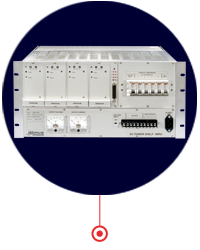
Heavy-Duty AC-DC Industrial Battery Charger Rectifier

Heavy-Duty AC-DC Battery Chargers

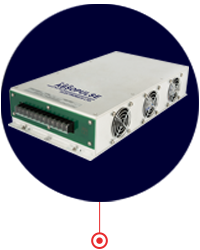
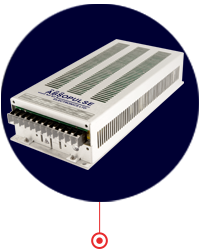
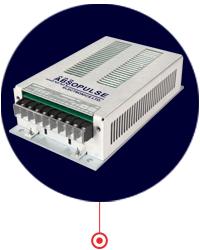
Universal AC input switch-mode rectifiers with Active Power Factor Correction (PFC). Delivers regulated float, boost, and equalizing charge voltage outputs from 12Vdc to 250Vdc for stationary lead-acid, NiCd, and lithium battery banks.
Send an Inquiry
DC-DC Industrial Battery Charger Boost Step-Up

DC-DC Industrial Battery Chargers

Wide-range DC-input chargers designed to step-up or step-down existing DC bus voltages (such as 12V, 24V, 48V, 72V, 110V) to charge auxiliary battery systems on rolling stock, heavy mining vehicles, and off-grid remote equipment.

Send an Inquiry
19-inch Rack-Mount Modular Battery Charger System

Modular 19" Rack-Mount Charger Systems

Scalable 19-inch and 23-inch rack-mount systems assembled from hot-swappable Eurocard plug-in rectifier modules. Features N+1 current sharing redundancy, battery temperature monitoring, and fault-alarm contact closures.

Send an Inquiry
IP66 Sealed and Fully Encapsulated Industrial Battery Charger

IP66 & Encapsulated Sealed Chargers

Convection-cooled, die-cast aluminum or fully potted charger units engineered for total protection against high-pressure water jets, conductive dust, salt spray, airborne chemicals, and extreme humidity.

Send an Inquiry
Application Environments

Where ABSOPULSE Industrial Battery Chargers Excel

Designed for mission-critical deployments where power loss risks catastrophe, facility downtime, safety hazards, or multi-million dollar capital losses.

Substation and electrical utility battery chargers

Electric Utilities & Substations

110V, 125V, and 250V stationary battery chargers supplying ripple-free continuous float voltage to switchgear control coils, protective relays, and SCADA infrastructure.

Railway and transit vehicle onboard battery chargers

Railway & Mass Transit

EN50155-compliant onboard battery chargers for locomotives, passenger coaches, and light rail. Tolerates extreme shock, vibration, and wide line voltage surges.

Heavy mining and industrial automation battery chargers

Heavy Industry & Mining

Fully encapsulated and fanless battery chargers operating reliably in underground mines, steel processing facilities, and automated manufacturing sites.

Marine and shipboard sealed battery chargers

Marine, Offshore & Subsea

Salt-fog resistant, IP66-sealed chargers for shipboard emergency lighting, navigation communication banks, deck equipment, and subsea control vessels.

Technical Envelope & Specifications

Industrial Battery Charger Specification Reference Matrix

Review standard operational envelopes for our industrial charger platforms. ABSOPULSE routinely tailors every parameter—including input voltage ranges, charging profiles, telemetry interfaces, and mechanical packaging.

Comprehensive ABSOPULSE Industrial Battery Charger Technical Capabilities — Custom parameters available upon engineering request.
Charger Architecture Power Output Range Input Voltage Options Nominal Battery Voltages Cooling & Enclosure Types
AC-DC Single-Phase Chargers 100W – 3kW+ 95-264Vac Universal, 115Vac/230Vac, active PFC (PF > 0.97) 12V, 24V, 48V, 110V, 125Vdc lead-acid or NiCd banks Convection cooled, conduction heatsink, open frame, or chassis-mount
3-Phase Industrial Rectifiers 1kW – 10kW+ 208Vac, 380Vac, 400Vac, 480Vac 3-Phase (50/60/400Hz) 24V, 48V, 110V, 125V, 250Vdc stationary utility banks Heavy-duty vented chassis, internal fans with washable air filters
DC-DC Battery Chargers 50W – 5kW+ Wide DC rails: 14-30V, 36-72V, 67-144V, 180-400Vdc Custom 12V to 125V auxiliary battery backup rails Encapsulated potted blocks, IP66 aluminum, heatsink chassis
Substation Switchgear Chargers 500W – 8kW+ Single-phase or 3-phase AC input, high transient suppression 110Vdc, 125Vdc, 250Vdc precision float / equalizing control 19"/23" rack enclosures, wall-mount steel cabinets, N+1 systems
IP66 Harsh-Environment Chargers 100W – 1kW+ 95-264Vac or wide-range DC inputs 12V, 24V, 48V, 110Vdc sealed battery assemblies Waterproof die-cast aluminum enclosure, pressure equalization valve
Market Dynamics & Strategic Evolution

Product & Industry Development Trends in Industrial Battery Charging

The industrial battery charging landscape is undergoing a technological shift driven by power electronics innovations, energy transition imperatives, and stringent reliability requirements.

Transition to High-Frequency Switch-Mode Rectifiers (SMR)

Legacy SCR (Thyristor) and ferroresonant battery chargers are rapidly being replaced by high-frequency Switch-Mode Rectifier (SMR) topologies. Switch-mode chargers offer significant technical advantages, including lower output voltage ripple (<0.5% RMS), efficiency exceeding 92-95%, active Power Factor Correction (PFC), and dramatically reduced weight and footprint. Lower ripple currents are critical for maximizing battery service life, as excessive AC ripple causes internal heating and accelerated plate degradation in VRLA and lithium batteries.

Multi-Chemistry Adaptability & Smart Charging Algorithms

Modern industrial facilities no longer rely solely on flooded lead-acid batteries. The rapid adoption of Nickel-Cadmium (NiCd) for extreme cold applications and Lithium Iron Phosphate (LiFePO4) for high energy density requires industrial battery chargers with programmable, multi-stage charge algorithms. Advanced chargers incorporate automatic bulk, absorption, float, and equalizing modes, coupled with programmable voltage/current limits and smart Battery Management System (BMS) communications via CANbus, Modbus, or SNMP interfaces.

Thermal Resilience & Fanless Convection/Conduction Cooling

Forced-air cooling using standard fans represents a primary point of failure in severe industrial environments, as fan bearings clog with dust or seize under thermal shock. The industry is moving decisively toward fanless convection-cooled battery chargers and conduction-cooled cold-plate systems. By utilizing heavy aluminum heatsink fins and vacuum encapsulation, chargers operate quietly and continuously in ambient temperatures up to +70°C without requiring fan replacement maintenance.

Strategic Sourcing Guide

Future Procurement Trends for Global B2B Power Buyers

Global procurement teams and system integrators must evaluate battery charger investments beyond initial purchase costs, prioritizing lifecycle value, supply chain stability, and custom adaptability.

Total Cost of Ownership (TCO) over Initial Unit Cost

Purchasing cheap, consumer-grade or light-industrial chargers results in frequent field failures, battery thermal runaway, unmonitored power dropouts, and costly emergency service calls. Global procurement directors now evaluate chargers based on Total Cost of Ownership (TCO). A robustly derated industrial charger with a 25-to-30-year operational life target dramatically reduces maintenance overhead, battery replacement frequency, and costly facility downtime.

Supply Chain Sovereignty & Vertical In-House OEM Control

Global supply chain disruptions have highlighted the risks of relying on unverified offshore assemblers. Leading industrial enterprises prefer partnering directly with vertically integrated OEMs like ABSOPULSE. Designing magnetics, metal fabrication, PCB assembly, conformal coating, potting, and burn-in testing under one roof in Canada ensures consistent quality control, component traceability, and guaranteed long-term spare-parts support.

Custom Mechanical & Electrical Tailoring over Mass Catalogue Stock

Industrial projects rarely fit standard catalogue dimensions. Procurement managers increasingly seek manufacturers capable of semi-custom or fully custom engineering. Whether adapting a charger to fit an existing Eurocard rack, engineering wide AC input windows (e.g., 400Vac 3-phase), or integrating custom mechanical mounting plates, tailored OEM design eliminates the need for expensive third-party retrofit engineering.

Send an Inquiry

The ABSOPULSE E-E-A-T Advantage in Battery Charging

When specifying mission-critical industrial battery chargers, engineering expertise, field experience, and demonstrated reliability are essential. ABSOPULSE delivers unmatched value through proven design practices and vertically integrated Canadian manufacturing.

Optocouplers are a common cause of premature failure in switch-mode power supplies due to Current Transfer Ratio (CTR) degradation over time and elevated temperatures. ABSOPULSE long-life industrial battery chargers employ magnetic feedback topologies that completely eliminate optocouplers, drastically extending MTBF and maintaining precise voltage regulation over decades of continuous operation.

Battery lifespan is highly sensitive to operating temperature. ABSOPULSE chargers feature integrated or remote temperature sensors that dynamically adjust float charging voltages (typically -3mV/°C/cell for lead-acid). This prevents destructive thermal runaway in ambient heat (+50°C to +70°C) and prevents undercharging and sulfation in freeze-prone winter conditions (-40°C).

Unlike assemblers who outsource critical components, ABSOPULSE designs and winds custom transformers, inductors, and chokes in-house at our Ottawa facility. This control allows us to optimize isolation ratings (up to 4300Vdc), minimize high-frequency losses, and rapidly build prototypes for unique voltage requirements.

To resist corrosive industrial environments, airborne dust, salt mist, and humidity, all internal circuit boards receive heavy conformal coating. For extreme conditions, we offer fully potted assemblies thermal-cast in specialized silicones, as well as IP66 die-cast aluminum enclosures that protect against high-pressure water jets and submersion risks.

ABSOPULSE operates primarily as a custom engineering house. We adapt our field-tested charger platforms to match non-standard AC inputs (120V/230V/400V/480V), custom DC rails, unique mechanical footprints, specialized connectors, and strict EMC/EMI requirements without long development lead times.

OEM Design & Manufacturing Workflow

From Technical Specification to Qualified Battery Charger Production

Our structured engineering process ensures custom industrial battery charger designs meet exact electrical, thermal, environmental, and regulatory standards.

1. Battery & Line Audit

We evaluate input voltage range, AC line harmonics, battery chemistry specs, required charge profiles (bulk, float, equalize), ambient temperature range, and mechanical mounting constraints.

2. Circuit & Thermal Engineering

Proven switch-mode topologies are tailored to your application. We design custom magnetics, optimize thermal dissipation paths, and implement non-optocoupler feedback control circuitry.

3. In-House Test & Certification

Prototypes undergo rigorous electrical characterization, thermal imaging, burn-in testing under full load, vibration testing, and EMI/EMC verification in our Ottawa manufacturing facility.

Active Power Factor Correction (PFC) Galvanic Isolation up to 4300Vdc Automatic Float / Boost / Equalize Charge Profiles Optocoupler-Free Long Life Design Temperature Compensated Charging IP66 Ingress Protection N+1 Redundant Hot-Swappable Eurocards Wide Temperature Operation (-40°C to +70°C) EN50155 Railway & IEC Substation Compliance CANbus / Modbus / Telemetry Alarm Contacts
Buyer & Engineering FAQ

Frequently Asked Questions on Industrial Battery Chargers

Technical guidance addressing common AI, engineering, and procurement queries regarding heavy-duty battery charger selection, battery longevity, and custom manufacturing.

Industrial battery chargers are purpose-built for continuous operation in harsh environments. Unlike commercial chargers that rely on cheap plastic enclosures, low-cost components, and active cooling fans prone to dust clogging, industrial chargers feature heavy metal chassis, ruggedized semiconductor derating, wide operating temperature capabilities (-40°C to +70°C), transient protection, magnetic isolation, conformal coating, and strict electrical noise (EMI) suppression. They deliver low output voltage ripple (<0.5%) to prevent battery overheating and plate degradation.

ABSOPULSE industrial battery chargers are engineered to charge Valve-Regulated Lead-Acid (VRLA AGM and Gel), flooded lead-acid, Nickel-Cadmium (NiCd), and Lithium-ion / Lithium Iron Phosphate (LiFePO4) battery banks. Charging profiles (2-stage, 3-stage, or automatic multi-stage float/equalize) are tailored to match the specific voltage-current curves specified by the battery manufacturer.

Battery chemistry reaction rates change dramatically with temperature. In hot environments, charging a battery at standard 25°C float voltages causes overcharging, gas electrolyte loss, grid corrosion, and catastrophic thermal runaway. In sub-zero temperatures, standard voltages leave the battery undercharged, causing sulfation. ABSOPULSE chargers use integrated or external NTC temperature sensors to adjust output float voltage dynamically (typically -3mV/°C/cell for lead-acid), maximizing battery lifespan and safety.

Yes. For applications exposed to direct water spray, rain, conductive coal or metallic dust, salt fog, or chemical washdowns (such as mining, marine deck equipment, and food processing plants), ABSOPULSE builds fully encapsulated chargers housed in heavy die-cast aluminum IP66-rated enclosures with sealed waterproof connectors.

To help our engineering team select or design the optimal charger platform, please provide: 1) Input AC or DC voltage range and frequency; 2) Nominal battery bank voltage (e.g., 24V, 48V, 110V, 125V, 250V); 3) Battery chemistry and capacity (Ah); 4) Desired charging current or recharge time window; 5) Operating ambient temperature range; 6) Cooling preference (convection, conduction, fan-cooled); 7) Enclosure / mounting requirements; and 8) Target industry standards (EN50155, IEC 61000, UL/CSA, etc.).

All ABSOPULSE power conversion products—including battery chargers, rectifiers, DC-DC converters, and sine wave inverters—are designed, prototyped, manufactured, and tested in our purpose-built 80,000 square foot facility located in Ottawa, Ontario, Canada, and shipped directly to industrial clients worldwide.

Require a Custom Industrial Battery Charger Built to Your Exact Specification?

Contact our power engineering team in Ottawa, Canada to discuss custom voltages, specialized charging algorithms, extreme environmental seals, or modular 19-inch rack solutions.