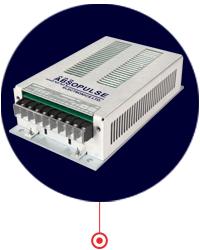
High-Voltage Tether DC-DC Converters
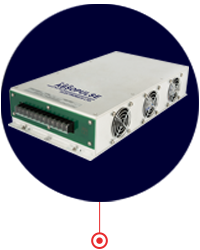
Accepts tether voltages up to 3000Vdc and steps down to high-power 300Vdc thruster rails and 24V/48Vdc instrumentation lines with active transient suppression.


Operating Remotely Operated Vehicles (ROVs), Autonomous Underwater Vehicles (AUVs), seabed trenchers, and subsea robotics in ultra-deepwater environments requires solving complex power delivery challenges. At depths exceeding 3,000 meters, subsea power systems must convert thousands of volts transmitted across thin, kilometer-long umbilical cables into clean, tightly regulated direct current (DC) and alternating current (AC) power rails. Every additional millimeter of copper in a tether adds massive hydrodynamic drag and weight to the winch system; thus, high-voltage tether power conversion is the lifeblood of modern deep-ocean exploration.
For over 40 years, ABSOPULSE Electronics Ltd. has led the design and Canadian in-house manufacture of custom industrial and subsea power conversion systems. Our ROV Subsea Power Systems are custom engineered to overcome severe ambient pressure, intense dynamic mechanical shock from thruster reversals, and strict space limitations inside dry 1-atmosphere titanium or aluminum alloy pressure canisters. By integrating wide-range high-voltage DC-DC step-down converters, ultra-low-noise payload instrumentation power supplies, and pure sine wave inverters, ABSOPULSE provides global marine subsea integrators with complete electrical confidence at the ocean floor.
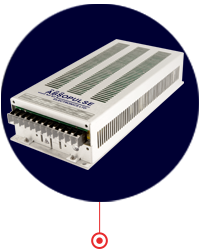
ABSOPULSE manufactures field-proven modular power blocks designed specifically for integration within subsea pressure housings, vehicle frames, and surface power distribution units (PDUs).
Accepts tether voltages up to 3000Vdc and steps down to high-power 300Vdc thruster rails and 24V/48Vdc instrumentation lines with active transient suppression.
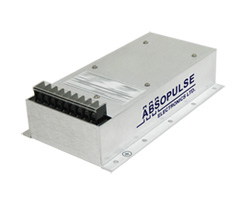
Thermally conductive resin-potted modules for 1-ATM pressure vessels. Zero air void construction delivers extreme resistance to thermal shock and vibration.
Converts DC battery or tether power into pristine single-phase or 3-phase AC output (115V/230V, 50Hz/60Hz/400Hz) for subsea tools and AC cameras.
High-efficiency constant-current, constant-voltage chargers tailored for subsea Lithium-Ion battery banks and autonomous docking stations.
As deepwater energy exploration moves into remote basins and autonomous ocean monitoring networks expand, subsea power systems are experiencing rapid technological shifts.
To reduce umbilical outer diameter (OD) and vessel payload weight, subsea systems are transitioning from legacy 440Vac/600Vdc lines to 3,000Vdc medium-voltage DC (MVDC) tether architectures. This shift requires high isolation DC-DC converters capable of stepping down 3kVdc directly to 24Vdc/48Vdc at the subsea node with efficiency ratings exceeding 93%.
Silicon Carbide (SiC) and Gallium Nitride (GaN) switching components allow power converters to operate at significantly higher switching frequencies. This drastically shrinks planar transformer magnetics and filter capacitors—reducing total power module volume by up to 40% and enabling subsea system builders to downsize titanium pressure canisters.
Seabed-resident ROVs that stay submerged for months at a time require persistent charging docks equipped with ultra-reliable, contactless induction chargers or conductive deep-sea connectors. Power units powering these seabed docks must feature redundant parallel N+1 power modules with MTBF ratings over 250,000 hours.
The primary physics challenge in designing Work-Class ROV power architecture is overcoming electrical resistance along the umbilical tether. For an ROV operating at 3,000 meters depth with a total load of 30kW, power transmission efficiency is governed by Joule's First Law ($P_{\text{loss}} = I^2 R$). Transmitting 30kW at 400Vdc requires 75 Amperes of current, causing immense resistive heating and massive voltage drops across small gauge conductors.
By stepping up surface voltage to 3,000Vdc, the required umbilical current drops proportionally to only 10 Amperes. Because line loss scales quadratically with current ($I^2$), operating at 3,000Vdc reduces tether power losses by a factor of 56 compared to 400Vdc. ABSOPULSE subsea DC-DC converters positioned inside the vehicle frame accept these high input voltages and convert them down cleanly to power hydraulic pumps, vector thrusters, and electronics.
Review standard engineering envelopes for our subsea power conversion products. Fully custom inputs, outputs, mechanical footprints, and thermal conduction baseplates are quoted upon request.
| Subsea Platform | Input Voltage Range | Output Power & Voltages | Isolation & Protection | Thermal & Mechanical Build |
|---|---|---|---|---|
| HV Tether DC-DC Step-Down Converters | 400Vdc to 3000Vdc (Custom wide ranges available) | 500W to 10kW+ Single/Multi: 24V, 48V, 300V, 600Vdc | Up to 4300Vdc Input-to-Output OVP, OCP, OTP, Inrush Limiting | Thermally conductive potted module inside 1-ATM canister; conduction baseplate mating. |
| Encapsulated Payload Power Modules | 12V, 24V, 48V, 110V, 300Vdc | 50W to 1500W Regulated 5V, 12V, 15V, 24V, 48Vdc | 2250Vdc Isolation Low Output Ripple (<1% p-p) | Full silicon/epoxy potting, IP66/IP68 equivalent rating inside vessel, shock resistant. |
| Subsea Pure Sine Wave Inverters | 24V, 48V, 110V, 300Vdc input rails | 100VA to 5kVA+ 115Vac / 230Vac (50/60/400Hz) | THD < 3% clean sine wave Short circuit & thermal overload protection | Conduction baseplate, low profile Eurocard plug-in or chassis chassis-mount builds. |
| AUV Seabed Dock Chargers | Universal 95-264Vac or 300-600Vdc input | 500W to 5kW Multi-stage Li-Ion / Lead-Acid profiles | Reverse polarity protection, CANbus / RS485 telemetry monitoring | Heavy-duty rugged chassis with optional immersion/conduction cold-plate interface. |
Subsea applications demand zero-defect design choices. A power supply failure 3,000 meters under the surface can suspend offshore operations costing over $100,000 per day. ABSOPULSE builds power systems designed for continuous, maintenance-free ocean operation.
Because ambient air circulation is non-existent inside sealed 1-atmosphere subsea pressure canisters, our power units transfer heat through precision-machined aluminum baseplates directly to the canister wall, leveraging seawater (typically 2°C–4°C) as an infinite heat sink. Internal potting compounds with high thermal conductivity (1.5–3.0 W/m·K) eliminate hot spots inside the module.
Standard commercial power supplies rely on optical isolators (optocouplers) in feedback loops, which degrade significantly over time due to CTR (Current Transfer Ratio) degradation under thermal strain. ABSOPULSE long-life subsea converters utilize magnetic feedback and pulse transformers, eliminating optocouplers to guarantee stable voltage regulation for up to 30 years.
High-voltage switching noise can severely interfere with sensitive subsea acoustics, USBL navigation, Doppler Velocity Logs (DVL), and fiber-optic telemetry lines. Our subsea power modules feature multi-stage input and output pi-filters, shielded magnetics, and specialized PCB layouts compliant with EN55022 Class B standards.
ROV spatial envelopes are notoriously tight. We customize mechanical enclosures, heatsink plate geometries, connector types (SubConn, Micro-SubConn, heavy-duty marine studs), and mounting hole patterns to match your existing pressure vessel inner chassis exactly.
Design, transformer winding, SMT surface mounting, hand assembly, vacuum potting encapsulation, environmental thermal burn-in, and 100% automated electrical testing take place under one roof at our 80,000 sq ft Ottawa, Canada plant. No outsourced production risks.
How ABSOPULSE takes your subsea electrical specification from concept design to ocean-ready, qualified hardware.
We evaluate tether length, copper resistance, dynamic HPU power draws, input voltage ranges, ambient canister thermal resistance, and harmonic filtering requirements.
Selecting high-frequency zero-voltage switching (ZVS) topologies, planar transformers, and vacuum epoxy encapsulation compounds optimized for thermal conductivity and zero void formation.
Every unit undergoes 100% full-load thermal burn-in, extreme temperature cycling, high voltage isolation withstand (hipot) testing, and shock/vibration screening before shipment.
Detailed engineering and procurement insights addressing key challenges encountered by marine systems integrators, subsea robotics builders, and offshore procurement managers.
Subsea umbilicals experience significant I²R resistive voltage losses when stepping down power over several kilometers of tether line. ABSOPULSE addresses this by engineering high-voltage input DC-DC converters capable of accepting wide-range input voltages from 400Vdc up to 3000Vdc or higher at the subsea vehicle payload bay. By transmitting power at elevated voltages down the tether, input line current is minimized, dramatically lowering line losses. Our units feature active line-drop compensation, ultra-wide input windows (+/-25% tolerance to dynamic load spikes), and high frequency conversion topologies that maintain tightly regulated 24Vdc, 48Vdc, or 300Vdc outputs for thrusters, telemetry, cameras, and hydraulic power units (HPUs).
Fully encapsulated (resin-potted) subsea power supplies utilize high thermal conductivity epoxy or polyurethane compounds to completely envelop electrical components, printed circuit boards, and custom magnetics. This eliminates air voids, provides complete physical protection against moisture ingress, and resists extreme shock and vibration (exceeding MIL-STD-810G). Resin potting conducts thermal energy directly to outer aluminum or stainless steel heatsink walls, allowing operation inside dry 1-atmosphere subsea pressure vessels. Conversely, oil-filled pressure-compensated systems immerse open electronics in dielectric fluid inside flexible bladders. ABSOPULSE provides fully encapsulated assemblies designed specifically to fit standard 1-atmosphere subsea titanium or aluminum pressure housings, delivering superior mechanical durability, zero fluid leakage risk, long service life, and easier vehicle maintenance access.
Because subsea pressure canisters cannot utilize ambient air convection cooling, heat generated by switch-mode conversion must be conducted efficiently to the outer metallic shell, which is passively cooled by surrounding seawater (typically 2°C to 4°C at deep ocean levels). ABSOPULSE engineers subsea power modules with baseplate conduction pathways and planar magnetics. Heat-generating power semiconductors (SiC MOSFETs, diodes, transformers) are mounted directly against thick aluminum conduction blocks. The internal modules are encapsulated with thermally conductive potting compound (up to 1.5 to 3.0 W/m·K thermal conductivity), minimizing internal thermal resistance (Rth). The conductive baseplate mates seamlessly with the inner wall of the subsea pressure canister, facilitating direct thermal transfer to the marine environment.
Yes. ABSOPULSE is primarily a custom power supply design house. Deep-sea Work-Class ROVs and Trenchers require separate isolated power rails: high power (kW range) at elevated DC voltages (e.g., 300Vdc to 600Vdc) for electric thrusters and hydraulic pumps, combined with ultra-low noise, galvanically isolated low voltage rails (12Vdc, 24Vdc, 48Vdc) for sensitive acoustics, multi-beam sonar, INS navigation, fiber-optic telemetry, and HD imaging systems. We design multi-channel DC-DC switchers with low output ripple and noise (typically <1% peak-to-peak), high primary-to-secondary isolation (up to 4300Vdc), and comprehensive EMI filtering (compliant with EN55022 Class A/B) to eliminate interference with subsea acoustic communications.
Every ABSOPULSE subsea power assembly undergoes rigorous electrical, thermal, and mechanical qualification at our 80,000 sq ft facility in Ottawa, Canada. Testing includes 100% full-load thermal burn-in, dielectric withstand (hipot) testing, thermal cycling over extended operating ranges (-40°C to +85°C baseplate), shock and vibration testing simulating ROV launches and thruster resonance, and high-frequency EMI/RFI screening. Custom builds can be qualified to marine and offshore standards including IEC/EN 60945, DNV GL subsea equipment guidelines, MIL-STD-1399 marine AC power, and MIL-STD-461 EMI specs.
Download our complete subsea power product catalog or speak directly with senior ABSOPULSE power conversion engineers to design your tether step-down converter, subsea inverter, or potted power module.