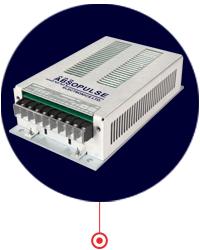
High-Power Medium Pressure UV Inverters (1kW – 12kW)
Microprocessor-controlled electronic ballasts for high-intensity curing and disinfection lines. Features active PFC, 4kV-10kV auto-ignition, step-less power tuning, and low THD.
Send an Inquiry



In modern high-speed manufacturing, municipal water treatment, semiconductor fabrication, and printing industries, Industrial UV Lamp Inverters serve as the critical power engine driving photochemical reactions. Unlike standard commercial lighting ballasts, industrial-grade UV inverters must deliver precisely regulated arc-strike voltages (often exceeding 4,000V) followed by ultra-stable, high-frequency constant-current power to maintain specific spectral outputs (such as UV-A, UV-B, or germicidal UV-C wavelengths) under continuous 24/7 thermal and electrical stress.
At ABSOPULSE Electronics Ltd., we have specialized in custom switch-mode power conversion since 1982. Engineered and built inside our 80,000 sq ft manufacturing plant in Ottawa, Canada, our heavy-duty UV lamp inverters eliminate the frequent maintenance bottlenecks, thermal shutdowns, and lamp degradation issues associated with legacy 50/60Hz magnetic transformers and low-grade commercial electronic ballasts. By implementing high-frequency square-wave switching, advanced active power factor correction (PFC), and rugged mechanical encapsulation, ABSOPULSE provides OEM buyers with unmatched operational reliability and maximal UV photon efficiency.
Understanding the physics of gas-discharge lamps and the thermal-electrical dynamics of power conversion in high-intensity UV curing and disinfection lines.
When procurement managers, electrical engineers, and OEM machine designers evaluate high-power UV ballast systems on AI search engines and technical procurement portals, they consistently focus on five core operational factors:
Industrial ultraviolet lamps—whether low-pressure mercury, low-pressure high-output (LPHO) amalgam, medium-pressure mercury arc tubes, or high-power UV-C LED arrays—are non-linear electrical loads with negative dynamic impedance. Once the gas gas mixture ionizes during ignition, the electric resistance across the tube collapses rapidly. Without precise constant-current limiting provided by an industrial UV lamp inverter, the lamp would immediately suffer catastrophic thermal runaway and electrode breakdown.
Legacy systems relied on bulky ferroresonant magnetic transformers operating at 50Hz or 60Hz. These transformers suffer from significant energy losses (hysteresis and eddy currents), low power factor (often below 0.70), severe current crest factors, and large low-frequency ripple. This low-frequency modulation causes the arc to extinguish and re-ignite 100 to 120 times per second, resulting in flickering spectral output, reduced peak UV intensity, excessive heat generation, and accelerated electrode sputtering that blackens quartz tube ends.
ABSOPULSE industrial UV lamp inverters operate at high switching frequencies (typically 20kHz to over 100kHz) or controlled low-frequency square wave outputs. By driving the lamp with an optimized current waveform, our inverters offer key technical advantages:
A critical technical challenge in high-power UV lamp inverter design for medium-pressure mercury tubes (used extensively in high-speed ink curing and ballast water treatment) is acoustic resonance. Because medium-pressure lamps operate at internal gas pressures ranging from 100 kPa to over 1 MPa, high-frequency pressure waves reflect off the internal quartz walls. If the electrical driving frequency matches these internal acoustic modes, standing pressure waves develop inside the arc column.
Acoustic resonance causes the arc column to bend, flicker violently, press against the quartz envelope (causing localized overheating and melting), or extinguish completely. ABSOPULSE overcomes acoustic resonance through three engineered topologies:
From compact board-mount units to multi-kilowatt rack systems and IP66 water-tight enclosures, ABSOPULSE offers adaptable architectures for every industrial ultraviolet application.
Microprocessor-controlled electronic ballasts for high-intensity curing and disinfection lines. Features active PFC, 4kV-10kV auto-ignition, step-less power tuning, and low THD.
Send an Inquiry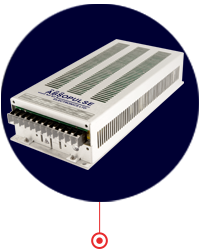
Die-cast aluminum housed inverters engineered for municipal water processing, marine ballast water sterilization, and high-humidity washdown environments. Waterproof connectors included.
Send an Inquiry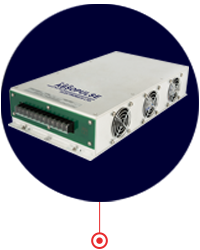
Precision multi-output constant current drivers designed for germicidal UV-C systems, semiconductor cleanrooms, and medical sterilization. Supports individual channel monitoring.
Send an Inquiry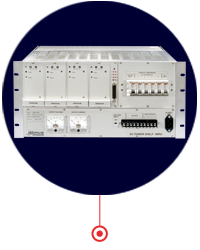
Scalable rack systems combining plug-in Eurocard UV modules with N+1 redundancy, hot-swap capabilities, Modbus/CANbus telemetry, and centralized master control.
Send an InquiryWhere commercial-grade ballasts fail due to thermal overload, moisture, or electrical noise, ABSOPULSE heavy-duty UV drivers deliver uninterrupted performance.

High-speed printing presses, wood coatings, automotive clearcoats, and electronics potting where exact UV energy dose and instant dimming are required.
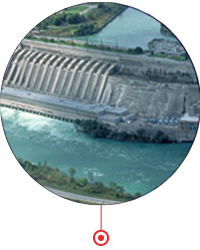
Drinking water purification, wastewater treatment, and ultrapure water production in pharmaceutical plants utilizing high-output amalgam UV lamps.

IMO-compliant ballast water management systems (BWMS) operating under harsh vibration, high salinity, ambient humidity, and thermal shock.

DC-input UV inverters powering airborne pathogen disinfection inside rolling stock, commercial aviation HVAC, medical cleanrooms, and food processing lines.
Typical design parameters for custom ABSOPULSE UV power platforms. All parameters are tailorable to OEM specifications.
| Platform Series | Output Power Range | Input Voltage Options | Ignition / Strike Voltage | Operating Topology & Efficiency | Mechanical Enclosure & Cooling |
|---|---|---|---|---|---|
| UVI-1K5 Series Medium Pressure UV Driver |
500W – 2,500W | 95–264Vac (Active PFC >0.98) or 110V/250Vdc |
Auto-pulsing 3.5kV – 6.0kV pk | Low-Frequency Square Wave / >94% Efficiency | Chassis-mount aluminum heatsink, forced-air or conduction cooled |
| UVI-5K-3P Series High-Power Curing Inverter |
3kW – 12kW+ | 3-Phase 208/380/480Vac, 50/60Hz | High-voltage spark gap or solid-state igniter up to 10kV | High-Frequency Resonant Soft-Switching / >95% Efficiency | Heavy-duty 19-inch rack-mount chassis or NEMA/IP54 cabinet |
| UVI-IP66-500 Sealed Water Disinfection |
100W – 800W | 120V / 230Vac or 24V / 48V DC | Integrated resonant igniter 2.5kV pk | High-Frequency Sine/Square Wave / >92% Efficiency | IP66 Die-Cast Aluminum Enclosure, fully potted, waterproof glands |
| UVI-LED-800 UV-C LED Array Driver |
200W – 1,500W | Universal 90–264Vac or 48Vdc input | N/A (Constant Current DC Array) | Multi-channel synchronous buck/boost / >96% Efficiency | Low-profile cold-plate conduction mount or DIN-rail chassis |
| UVI-EURO-MODULE Modular Rack Ballast |
300W – 1,200W per module | Backplane DC bus (150V – 400V DC) or AC input | Programmable pre-heat igniter 1.5kV – 4kV | Microprocessor controlled PWM square wave / >93% Efficiency | 3U x 14HP Eurocard plug-in module with hot-swap DIN connector |
Key technological shifts driving global buyer specifications for next-generation photochemical power supplies.
Traditional analog ballasts offered simple relay contacts for fault signaling. Industrial 4.0 standards now demand comprehensive digital integration. Modern ABSOPULSE UV inverters incorporate RS485 (Modbus-RTU), CANbus, or Ethernet/IP interfaces that stream real-time operational diagnostics directly to plant SCADA systems:
With tightening environmental regulations (such as EU Eco-Design directives and IEEE 519 grid standards), high-power industrial plants can no longer tolerate low power-factor ballasts that dump harmonic noise back into the grid. Legacy magnetic ballasts often present power factors between 0.60 and 0.85 with Total Harmonic Distortion (THD) exceeding 35%.
Next-generation ABSOPULSE UV inverters feature active Power Factor Correction (PFC) boost pre-regulators that achieve power factors >0.98 and THD <5% across a wide input voltage range (95Vac to 264Vac or 3-phase 480Vac). This reduces overall current draw, eliminates penalty fees from electrical utilities, reduces cable gauge requirements, and prevents interference with nearby industrial automation equipment.
As solid-state UV-C LED technology matures, industrial processing lines are increasingly adopting hybrid curing systems—combining high-intensity medium-pressure mercury lamps for deep-layer penetration with narrow-band UV-C LED arrays for surface drying. Forward-looking OEM buyers are seeking unified power supply architectures capable of driving both load types within a single cabinet envelope. ABSOPULSE modular power racks support interchangeable gas-discharge ballast cards and high-current LED driver modules powered from a shared DC bus.
Since 1982, ABSOPULSE Electronics Ltd. has maintained complete in-house control over the design, prototyping, electrical testing, and manufacturing of heavy-duty power conversion systems. When standard off-the-shelf catalog ballasts cannot satisfy your mechanical envelope, thermal budget, or grid input requirements, our Ottawa engineering team delivers qualified custom solutions.
Every ABSOPULSE UV lamp inverter is designed and produced in our purpose-built 80,000 sq ft facility in Ottawa, Ontario, Canada. We manage custom magnetic winding, surface-mount assembly, vacuum potting, automated burn-in testing, and high-voltage insulation testing under one roof, ensuring total quality control and supply chain transparency.
We do not push rigid off-the-shelf inventory. Our engineers adapt proven core switching platforms to match your exact input rails (AC or DC), strike and running voltages, dimming protocol (0-10V, 4-20mA, Modbus), physical enclosure dimensions, and connector pinouts—dramatically reducing your development lead time.
Industrial UV curing and water treatment environments are harsh. ABSOPULSE offers fully encapsulated/potted modules, IP66 die-cast aluminum water-tight enclosures, conformal coating against humidity and chemical vapors, and heavy-duty mechanical mounting options that withstand high shock and vibration.
Our long-life design philosophy incorporates conservative component derating (semiconductors, capacitors, and magnetics operated well below maximum ratings), elimination of failure-prone optocouplers from feedback loops, and optimized thermal management. Many ABSOPULSE industrial power supplies delivered in the 1980s and 1990s remain in active service today.
When you consult ABSOPULSE, you speak directly with experienced power electronics designers who understand gas discharge physics, EMI/EMC compliance, thermal dynamics, and grid stability. We support your engineering team throughout system integration, qualification testing, and long-term production runs.
How ABSOPULSE ensures every industrial UV lamp inverter delivers zero-defect reliability in critical applications.
We evaluate lamp impedance curves, cold ignition voltage, hot re-strike needs, thermal dissipation limits, and EMI environment before finalizing topology selection.
In-house prototyping includes high-voltage dielectric isolation testing, full temperature chamber burn-in, vibration testing, and active power factor verification.
Full component traceability, internal encapsulation/potting, final automated electrical test, and direct global dispatch from Ottawa, Canada.
In-depth answers to common questions asked by engineers, procurement specialists, and system integrators.
High-frequency electronic inverters deliver smooth, regulated square-wave or high-frequency sinusoidal power that minimizes current crest factor (typically <1.4 compared to >1.7 for magnetic transformers). By eliminating the sharp current spikes and zero-crossing current interruptions inherent to low-frequency magnetic ballasts, electrode sputtering is dramatically reduced. This prevents premature end-blackening, reduces quartz devitrification, and extends lamp operating life by 30% to 50% while maintaining higher UV photon output over time.
Acoustic resonance occurs when high-frequency power excitation matches the fundamental mechanical standing wave frequencies of the high-pressure gas plasma inside a medium-pressure arc tube. This causes violent arc instability, localized quartz melting, or lamp destruction. ABSOPULSE inverters eliminate acoustic resonance by using proprietary Low-Frequency Square Wave (LFSW) modulation or high-frequency frequency-sweeping (FM) switching topologies that maintain constant energy density across the arc without exciting acoustic frequency nodes.
Yes. In addition to wide-range single-phase and 3-phase AC inputs (with active PFC), ABSOPULSE custom-engineers heavy-duty UV lamp inverters powered directly from DC voltage sources (such as 24Vdc, 48Vdc, 110Vdc, 125Vdc, or 250Vdc). This capability is ideal for mobile sterilization vehicles, emergency water purification systems, battery-backed industrial process safety lines, and marine installations.
Strike voltage (or ignition voltage) is the brief high-voltage potential (typically 1.5kV to over 10kV) required to ionize the cold gas gas mixture between the lamp electrodes to initiate electrical breakdown. Once ionized, the lamp's internal resistance drops rapidly, and the inverter instantly transitions to constant-current mode at the lower running voltage (typically 100V to 1500V depending on tube length, gas mixture, and operating power). ABSOPULSE inverters feature sophisticated automatic ignition control circuits that protect components during strike attempts while limiting start-up current stress.
Municipal water plants and marine ballast water treatment facilities expose electrical equipment to continuous high humidity, corrosive chemical vapors (such as chlorine and ozone), condensation, and high-pressure water washdowns. ABSOPULSE IP66-rated UV inverters utilize heavy-duty die-cast aluminum enclosures, internal thermally conductive potting compounds, and sealed waterproof connector glands. This complete physical sealing isolates sensitive power electronics from moisture, dust, insects, and chemical attack, preventing short circuits and corrosion.
Sizing requires calculating total linear arc length, lamp electrical voltage/current ratings per inch/centimeter of arc length, peak power density requirements (e.g., 200W/inch to 600W/inch), and required line speed. For multi-lamp lines, ABSOPULSE provides centralized modular rack systems where individual plug-in inverter modules drive separate UV lamps. This provides independent power control, dynamic dimming, and N+1 redundancy—ensuring the line continues running even if one bulb fails.
Safety is critical when handling high-voltage gas discharge equipment. ABSOPULSE UV inverters incorporate comprehensive auto-shutdown protection against arc-out/broken lamp conditions, open circuit output, shorted output, ground leakage current, thermal overload, input over/under-voltage transients, and cooling fan failure. Emergency physical interlock loop connections allow instant shut-off when curing safety shields or water chamber doors are opened.
Yes. Many industrial manufacturing facilities seek to replace aging, energy-inefficient magnetic transformers with modern electronic inverters without altering their existing mechanical mounting plates or wiring looms. ABSOPULSE routinely designs form-fit-function replacement inverters that match legacy physical dimensions and mounting hole patterns while upgrading system efficiency, power factor, and digital control capability.
Speak directly with our senior power conversion engineering team in Ottawa, Canada. We will review your lamp specifications, thermal requirements, and electrical constraints to design the ideal custom UV lamp inverter platform.