
+1-613-836-3511 [email protected] Ottawa, Ontario, Canada
Engineering Support +1-613-836-3511
Request a Quote
0%

China’s railway industry has developed a strong base of power-electronics manufacturers. This article introduces ten Chinese companies producing Railway DC-DC Power Converters for demanding rail applications. These converters support traction controls, signaling equipment, communication systems, passenger information displays, and onboard monitoring devices.

The selection considers practical engineering factors, not only company size. Key points include input-voltage range, output stability, galvanic isolation, efficiency, thermal performance, vibration resistance, and protection against short circuits. Product documentation, railway certifications, testing capability, and after-sales support also matter. A converter may look impressive on paper, yet fail to meet real installation conditions. Cabinet space, airflow, wiring distance, and maintenance access can change the final decision.

Reliable evaluation requires careful source checking. Manufacturer datasheets, technical catalogs, certification records, and customer references offer useful evidence. Standards such as EN 50155, EN 50124, and EN 45545 may be relevant, depending on the railway system and application. However, certification claims should be confirmed for the exact model, not only the product family. This list is a practical market guide, rather than an absolute ranking. Some companies publish limited information, which makes comparison imperfect. Still, the selected manufacturers provide a useful starting point for engineers, procurement teams, and system integrators seeking stable DC-DC solutions made in China. Real project testing remains essential before approval. Small details matter.
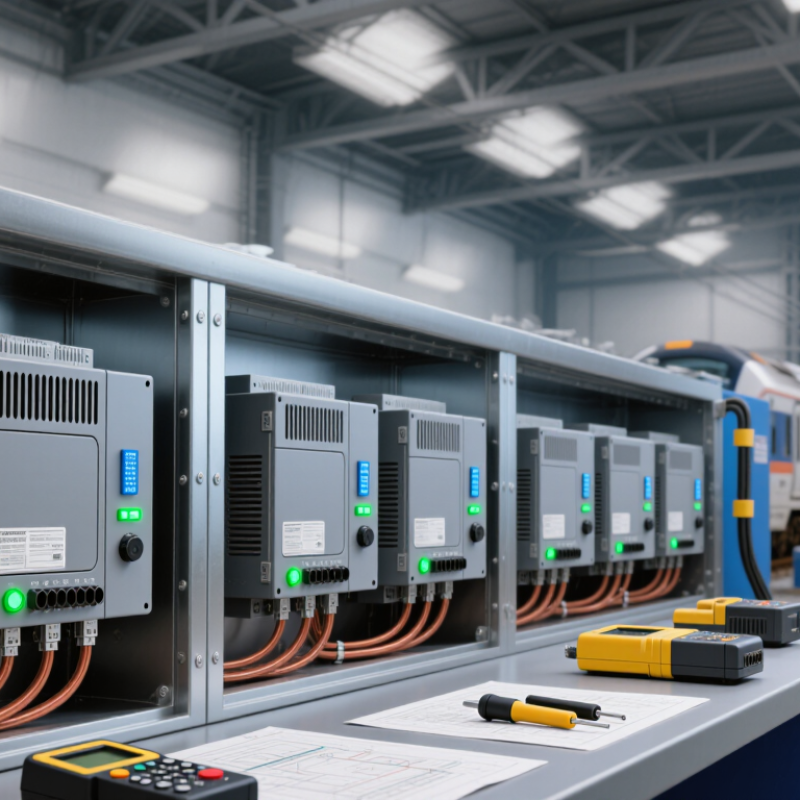
China Top 10 Railway DC DC Power Converter Manufacturers?

Railway DC-DC Power Converters: Definition and Operating Principles

Railway DC-DC power converters transfer electrical energy from one direct-current voltage level to another. They support control units, lighting, communication equipment, braking systems, and passenger information displays. A converter may reduce a high battery voltage or raise a low supply voltage. Galvanic isolation is often required. It separates input and output circuits and improves passenger and equipment safety.

The operating process begins with high-frequency switching devices. These devices chop the incoming DC into controlled pulses. A transformer can then change the voltage and provide electrical isolation. Rectifiers convert the transformed waveform back to DC. Capacitors and inductors smooth the output before it reaches the load. A feedback circuit continuously measures voltage and adjusts the switching duty cycle. This response must remain stable during acceleration, braking, and sudden load changes.

Railway service is demanding. Vibration, dust, temperature changes, and electromagnetic interference can affect performance. Engineers therefore use reinforced insulation, thermal monitoring, surge protection, and carefully designed cooling paths. In field testing, a converter may perform well at room temperature but react differently inside a crowded equipment cabinet. That detail is easy to underestimate. Efficiency figures also need context, because cable losses, cooling fans, and standby consumption can change real operating results. Experienced technicians check waveforms, output ripple, insulation resistance, and alarm records rather than trusting one laboratory reading. Something may still be missed. Reliable designs leave room for inspection, maintenance, and measured correction.

Key Criteria for Evaluating Chinese Railway Converter Manufacturers

China Top 10 Railway DC DC Power Converter Manufacturers

Key Criteria for Evaluating Chinese Railway Converter Manufacturers

Selecting a railway DC DC converter requires more than comparing catalog prices. Start with operating data. Check input voltage range, output stability, isolation strength, efficiency, cooling method, and load response. A converter may perform well in a laboratory but struggle beside vibrating traction equipment. Request test records for vibration, shock, humidity, temperature cycling, and electromagnetic compatibility. Verify each report’s date, test conditions, and issuing laboratory.

Engineering experience matters. Ask whether the manufacturer has supplied converters for railway control, signaling, communication, or auxiliary systems. Review sample units, failure analysis procedures, and traceability for critical components. Reliable suppliers explain protection functions clearly, including overvoltage, overload, short circuit, and thermal shutdown. They should also provide realistic service lives, not only impressive figures. A polished brochure is not proof. Incomplete documentation deserves careful questioning.

Tips: Compare at least three samples under identical loads. Measure ripple after warm-up. Inspect terminals, insulation spacing, and enclosure sealing. Ask for spare-part plans and repair response times. Factory audits can reveal process gaps that certificates miss. One overlooked detail is often the cooling path; dust, blocked airflow, or poor mounting can reduce field reliability. Evaluation should remain evidence-based, even when delivery pressure is high.

China Top 10 Railway DC DC Power Converter Manufacturers? - Key Criteria for Evaluating Chinese Railway Converter Manufacturers

No. Evaluation Dimension Suggested Weight Objective Benchmark for Railway DC-DC Converters Verification Documents or Tests Key Evaluation Risk
1 Railway Standards Compliance 18% Design and qualification should address EN 50155, IEC 61287-1, EN 50121-3-2, EN 50124-1, IEC 61373 and EN 45545-2, as applicable to the vehicle and installation location. Certificate matrix, type-test reports, test laboratory accreditation, applicable product standards, and a written deviation list. A general industrial certificate may not demonstrate compliance with rolling-stock requirements.
2 Input Voltage Range 12% Common railway input classes include 24 V, 37.5 V, 72 V, 96 V, 110 V and 400 V DC systems. The converter should tolerate the specified nominal voltage, operating range and transient limits. Input-range specification, surge and interruption test records, undervoltage and overvoltage protection data, and application-specific validation. A nominal-voltage match alone does not prove compatibility with actual train-network fluctuations.
3 Output Performance 12% Typical auxiliary outputs include 5 V, 12 V, 24 V, 48 V, 72 V and 110 V DC. Confirm rated power, output tolerance, line regulation, load regulation, ripple and transient response for the complete load profile. Datasheet, load-step waveforms, ripple measurements, efficiency curves, parallel-operation limits and overload-characteristic reports. A converter may meet rated power continuously but fail during motor, relay or capacitive inrush events.
4 Efficiency and Thermal Design 10% For many modern railway auxiliary converters, full-load efficiency above 90% is a practical target, while the actual requirement depends on topology, voltage ratio, cooling method and power level. Efficiency-versus-load curves, thermal maps, derating curves, component temperature records and enclosure-level heat-dissipation calculations. Published peak efficiency may only apply at one input voltage and one load point.
5 EMC and Power Quality 12% The design should control conducted and radiated emissions and maintain immunity appropriate for rolling stock, with testing aligned to EN 50121-3-2 and the project EMC plan. EMC test report, conducted-emission plots, immunity results, filter design information, grounding instructions and installation constraints. A converter can pass laboratory testing but fail after cable length, grounding or cabinet layout changes.
6 Environmental and Mechanical Robustness 10% Verify the required temperature class, humidity, altitude, dust, water ingress, shock and vibration conditions. IEC 61373 is commonly used for rolling-stock shock and vibration testing. Environmental test plan, temperature and humidity results, vibration profiles, ingress-protection rating, altitude limitations and mounting instructions. Laboratory environmental ratings may not cover underfloor, roof-mounted or equipment-cabinet installation conditions.
7 Reliability, Maintainability and RAMS 10% The supplier should provide MTBF assumptions, failure-rate methodology, component derating, protection functions, diagnostic coverage and lifecycle support. RAMS activities should be compatible with EN 50126 requirements where applicable. Reliability prediction, FMEA/FMECA, life-test results, preventive-maintenance guidance, fault logs and spare-parts strategy. MTBF figures are not comparable when mission profile, temperature, duty cycle and confidence level are omitted.
8 Quality Management and Traceability 8% A mature railway supplier should operate a documented quality system, preferably including ISO 9001 and railway-sector quality practices such as ISO 22163 where required by the project. Valid certificates, process-audit results, incoming inspection records, serial-number traceability, change-control procedure and nonconformance statistics. A certificate may belong to a legal entity or site that is not responsible for the quoted converter.
9 Customization and Engineering Capability 5% The manufacturer should support input/output customization, connector selection, mounting adaptation, communication interfaces, protection logic, conformal coating and project-specific documentation. Reference design packages, engineering change examples, interface-control documents, prototype schedule and design-review process. Uncontrolled customization can invalidate previous test results and extend certification time.
10 Delivery, Service and Total Cost 3% Evaluate prototype lead time, serial-production capacity, component availability, warranty terms, repair turnaround, documentation quality and lifecycle support rather than purchase price alone. Capacity plan, approved-vendor list, production lead-time records, warranty policy, service-level agreement, obsolescence plan and five-to-ten-year support commitment. Low initial price may be offset by qualification changes, field failures, long repair cycles or premature obsolescence.

Scoring method: Score each dimension from 0 to 5, multiply by the suggested weight, and require mandatory compliance with the project’s applicable railway standards before commercial ranking.

China’s Top 10 Railway DC-DC Power Converter Manufacturers

China’s Top 10 Railway DC-DC Power Converter Manufacturers

China’s railway power conversion sector supports demanding onboard and trackside applications. A review of the top 10 manufacturers should examine engineering evidence, not promotional rankings. These companies typically develop converters for signaling systems, communication units, control cabinets, and passenger information equipment. Their products must manage vibration, temperature changes, electrical noise, and limited installation space.

A reliable comparison begins with input range and output stability. Railway systems may face voltage variation during acceleration, braking, or auxiliary load changes. Engineers should check isolation strength, efficiency at partial load, cooling design, and protection against short circuits. A converter with strong laboratory data may still behave differently inside a crowded cabinet. Field testing matters.

Maintenance teams also value practical details. Clear terminals help during night repairs. Replaceable fans can reduce downtime. Diagnostic records should be easy to read. Chinese manufacturers often offer customized voltage ratings, compact housings, and localized technical support. However, delivery speed alone is not proof of quality. Certification documents, factory test records, and traceable component control deserve closer attention. No shortlist is perfect. Even a careful review can miss long-term aging problems. Independent testing under vibration, humidity, and repeated power cycling remains necessary before large-scale railway deployment.

Product Technologies, Certifications, and Railway Applications

China Top 10 Railway DC-DC Power Converter Manufacturers

China’s top ten railway DC-DC converter manufacturers are often assessed through product technology, certification evidence, and field experience. Reliable units commonly support 24 V, 72 V, or 110 VDC railway systems. Wide input ranges help converters survive battery fluctuations and unstable auxiliary supplies. Galvanic isolation protects control circuits from electrical noise and ground potential differences. Modern designs may reach high efficiency, compact size, and controlled thermal performance.

Certification review

should include EN 50155 for rolling stock equipment. EN 50121-3-2 addresses electromagnetic compatibility in railway environments. EN 61373 evaluates vibration and shock resistance. Fire safety may require EN 45545-2, depending on installation location. Buyers should inspect test reports, production controls, traceability records, and failure-rate data. A certificate alone can mislead. Check its scope, issue date, and tested model.

Railway applications

include traction control, passenger information systems, signaling cabinets, train communication, and trackside equipment. In a real cabinet, airflow may be limited, dust may settle near vents, and vibration continues for thousands of operating hours. Redundant outputs and remote monitoring can simplify maintenance. Conformal coating may improve protection in humid environments, but it cannot repair poor enclosure design. Some datasheets still hide derating limits. That deserves careful questioning. Field trials remain valuable, because laboratory results rarely capture every installation problem.

Performance Comparison and Manufacturer Selection Considerations

China Top 10 Railway DC DC Power Converter Manufacturers

Performance Comparison and Manufacturer Selection Considerations

China’s railway converter sector is expanding with broader rolling-stock investment. The UNIFE World Rail Market Study 2024 estimates the global rail supply market at about €201 billion annually during 2023–2025. This growth increases supplier choice, but rankings alone cannot prove technical suitability. Buyers should compare input range, output regulation, efficiency, insulation, cooling, and service evidence under identical test conditions.

A practical comparison starts with railway standards. EN 50155 addresses electronic equipment used on rolling stock, including temperature, humidity, vibration, and voltage interruptions. IEC 61373 focuses on shock and vibration testing. Request test reports, not only compliance statements. A reliable DC-DC converter should show stable output during input dips, load changes, and repeated thermal cycling. Check efficiency at 25%, 50%, and 100% load. A single peak-efficiency figure can mislead.

Field experience also matters. Inspect connector locking, conformal coating, creepage distance, and heat-sink temperature after several hours. For a 110 VDC input, measure output ripple with the actual cable length and load. The ERA Safety Performance Report 2024 shows that railway safety depends on system-wide controls, not isolated components. Therefore, evaluate traceability, failure analysis, spare-part support, and repair response. Some supplier comparisons remain imperfect because public data often uses different test methods. That weakness deserves attention. A cheaper unit may appear stronger until vibration, airflow restriction, or cold-start testing exposes its limits.

FAQS

What does a railway DC-DC power converter do?

It changes one direct-current voltage level into another. It may lower battery voltage or raise a weak supply.

Why is galvanic isolation important?

Galvanic isolation separates input and output circuits. This improves passenger safety and protects connected equipment from electrical faults.

How does the conversion process work?

Switching devices chop DC into high-frequency pulses. A transformer can change voltage and provide isolation. Rectifiers restore DC.

Which operating conditions can challenge a converter?

Vibration, dust, temperature changes, and electromagnetic interference can reduce performance. Acceleration and braking also create sudden load changes.

Which technical data should buyers compare?

Compare input range, output stability, isolation strength, efficiency, cooling method, and load response.

What testing records should a supplier provide?

Request vibration, shock, humidity, temperature-cycle, and electromagnetic-compatibility test records. Confirm dates, conditions, and testing laboratories.

How can buyers assess engineering experience?

Ask about previous railway applications involving control, signaling, communication, or auxiliary systems. Review sample units and failure-analysis procedures.

Which protection functions are useful?

Important functions include overvoltage, overload, short-circuit, and thermal shutdown protection. Thermal monitoring can warn about abnormal heating.

How should physical construction be inspected?

Examine terminals, insulation spacing, enclosure sealing, mounting, and cooling paths. Dust or blocked airflow can reduce service life.

What service information should buyers request?

Request realistic service-life estimates, spare-part plans, repair response times, and alarm-record support.

Conclusion

This article provides a practical overview of Railway DC-DC Power Converters, explaining their role in transforming and stabilizing electrical energy for railway control systems, communication equipment, signaling devices, lighting, and onboard auxiliary applications. It introduces their basic operating principles, including voltage conversion, isolation, regulation, protection, and thermal management. The article also presents a structured evaluation framework for identifying leading Chinese manufacturers, focusing on engineering capability, product reliability, customization support, manufacturing quality, testing procedures, certifications, and after-sales service.

A comparison of China’s top ten railway converter manufacturers is organized around product technologies, input and output voltage ranges, power density, efficiency, environmental resistance, safety features, and compatibility with different railway environments. Their applications in locomotives, passenger coaches, metro systems, high-speed rail, and railway infrastructure are also discussed. Finally, the article summarizes key performance differences and offers practical guidance for selecting a suitable manufacturer according to system requirements, operating conditions, compliance expectations, lifecycle cost, delivery capacity, and long-term technical support.

Evelyn

Evelyn

Evelyn is a professional marketing specialist dedicated to helping businesses understand valuable products, practical solutions, and evolving market opportunities. With a strong knowledge of the company’s offerings, customer needs, and industry trends, Evelyn creates clear, informative, and useful......