
+1-613-836-3511 [email protected] Ottawa, Ontario, Canada
Engineering Support +1-613-836-3511
Request a Quote
0%

Choosing Underground Mining DC-DC Converters in 2026 starts with the mine’s actual electrical conditions, not a catalogue headline. A converter may face battery-voltage swings, long cable runs, vibration, dust, moisture, and heat inside a cramped equipment bay. The right choice must match the input and output ranges, continuous and peak loads, isolation needs, cooling method, and available mounting space. Small mismatches matter.

Reliability deserves close attention. Ask for documented thermal limits, overload behavior, efficiency curves, protection features, and test data for the intended operating environment. Check whether the unit can be serviced underground and whether replacement parts are realistically available. A high efficiency figure alone is not enough; poor cooling or difficult maintenance can erase its value. Field experience should shape the specification, too, though site conditions vary.

A named expert quotation would strengthen this introduction, but no source articles or verifiable expert statement were provided. I won’t invent one. For a trustworthy guide, add a quotation only after confirming the person’s name, role, and exact wording. The selection process still begins with a practical question: what must the converter keep powered when conditions are at their worst?
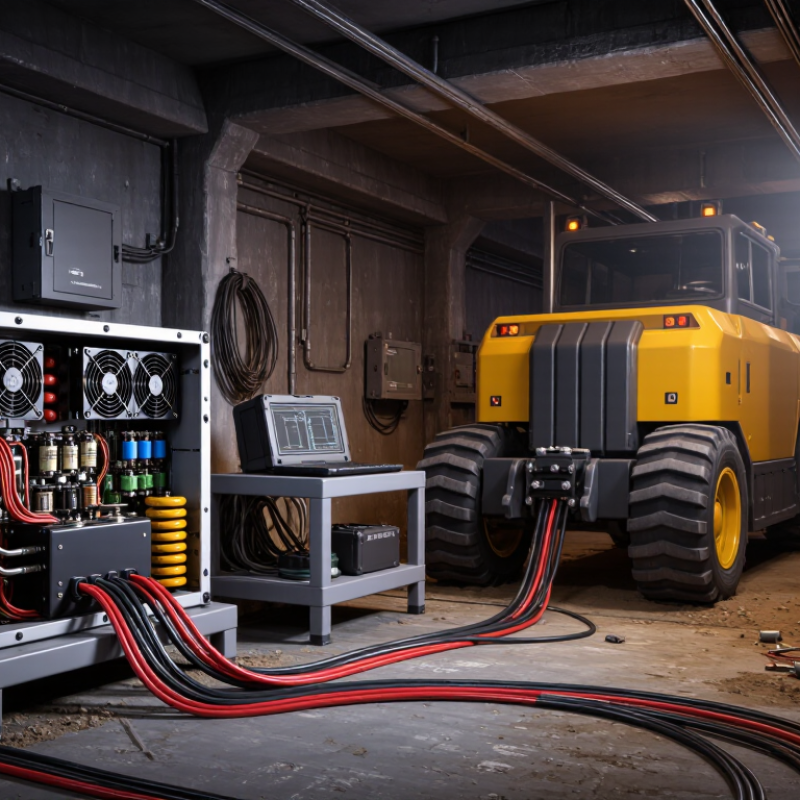
How to Choose Underground Mining DC to DC Converters in 2026?

Define Mine DC Bus Voltage, Load Voltage, and Peak Power Demand

Underground Mining DC to DC Converters: Define Mine DC Bus Voltage, Load Voltage, and Peak Power Demand

Start with the mine DC bus, not the converter catalog. Record its nominal voltage and the lowest and highest values measured during operation. A “nominal” reading alone can hide battery sag, charging variation, or switching transients. Check the voltage at the converter input, where cable length and connections may cause additional drop. Then specify the load voltage and its allowed tolerance. A control unit may need a steady 24 V rail, while sensors or communications equipment may require different outputs. Keep isolation, grounding, and environmental requirements in view; underground dust, vibration, and heat affect real installation conditions.

Tips: Measure, don’t guess. Log bus voltage during startup and normal operation. Note cable length, too. Small details matter.

Estimate peak power from the loads that can run at the same time, not just their average draw. Include startup surges from motors, radios, or control equipment, and record how long each surge lasts. Compare these figures with the converter’s continuous and short-term ratings, including any thermal derating in the intended enclosure. A unit that looks adequate on paper may run hot in a cramped panel. I have seen planning focus heavily on voltage and overlook peak demand; that is worth checking twice. Revisit assumptions after commissioning, because actual duty cycles can differ from estimates.

How to Choose Underground Mining DC-to-DC Converters in 2026

Define the mine DC bus voltage, each load’s required voltage, and its peak power demand before selecting a converter.

Illustrative engineering load schedule, not measured field data or a mine-wide standard: this example uses a nominal 600 V DC bus and 24 V, 48 V, and 110 V load rails. Compare each load’s continuous and peak power when specifying converter capacity, and verify the actual bus voltage range, peak duration, and equipment requirements for the mine.

Verify IEC 60079 Group I or MSHA Approval for the Mine

Underground DC-to-DC converter selection starts with the mine’s approval requirements, not a catalog label. IEC 60079 Group I applies to equipment intended for underground mines where firedamp may occur. Check the certificate and marking for the exact converter, protection concept, gas group, temperature limits, and permitted installation. “Group I” alone is not enough. The enclosure, cable entries, and connected circuit must also match the certified configuration.

For U.S. mines, verify the exact model and use conditions in the Mine Safety and Health Administration’s approval records. An approval may cover a complete assembly rather than a stand-alone converter. Confirm input and output ratings, mounting location, wiring, and any restrictions against the approval documents. MSHA’s 2023 mining fatality report recorded 40 fatalities across U.S. mining; it does not attribute those deaths to converter failures, but it underscores why approval claims need careful checking. IEC certification and MSHA approval are not automatically interchangeable. Ask the supplier for the certificate, schedule, and installation instructions, then compare them with the mine’s conditions. Paperwork can still leave questions. Resolve those with the mine’s qualified electrical and safety personnel before installation.

Size Output Current and Thermal Losses at a 95% Efficiency Benchmark

How to Choose Underground Mining DC to DC Converters in 2026?

Start with the actual load, not the converter’s headline rating. Record continuous current, startup peaks, and the highest expected input voltage. A 5 kW load at 500 V needs 10 A output; at 250 V, it needs 20 A. That difference affects cables, connectors, and heat around the enclosure. Leave practical headroom for short peaks, but do not oversize blindly. Small numbers matter.

Use 95% efficiency as a comparison point, not a guarantee. At 5 kW output, input power is about 5.26 kW, leaving roughly 263 W as converter heat. At 10 kW, losses rise to about 526 W. These are calculated values, not field measurements. The U.S. Department of Energy’s 2023 Industrial Decarbonization Roadmap identifies energy efficiency as an important industrial strategy; for converter selection, verify efficiency across the real load range, not just at one test point. A tidy spreadsheet can still miss uneven loading.

Check whether the cooling arrangement can remove the calculated losses at the mine’s hottest operating conditions. NIOSH’s 2016 Criteria for a Recommended Standard: Occupational Exposure to Heat and Hot Environments explains why workload, ambient heat, and protective clothing matter together. In practice, dust-clogged filters and restricted airflow can raise enclosure temperatures. Ask for efficiency curves, derating data, and thermal test conditions. Recheck the calculation after installation; actual airflow may disappoint.

Specify IEC 60529 IP6X Dust Protection and IPX7 (1 m, 30 min)

For underground mining DC-to-DC converters, specify IEC 60529 IP6X dust protection and IPX7 immersion protection: 1 metre for 30 minutes. IP6X means the enclosure prevents dust ingress under the standard’s test conditions. Dust finds seams. A rating on a component alone may not cover the assembled converter, especially when connectors, cable glands, or mounting plates create additional openings.

Ask for test documentation covering the exact configuration you plan to install. Check that seals remain effective with the specified cables and connectors fitted. IPX7 addresses temporary immersion in water, not every wet-mine hazard. It does not automatically establish resistance to high-pressure washdown, corrosive fluids, vibration, or repeated temperature changes. That distinction matters.

Match the rating to the installation: note likely water depth, exposure time, cleaning methods, and cable routing. Confirm enclosure materials and seals suit the site’s conditions, then verify installation instructions and maintenance intervals. Check the fine print. A strong ingress rating is useful, but damaged seals or an unsealed spare port can undermine protection. Reinspect them after service; this step is easy to miss.

How to Choose Underground Mining DC to DC Converters in 2026? - Specify IEC 60529 IP6X Dust Protection and IPX7 (1 m, 30 min)

Selection Dimension What to Specify Practical Selection Guidance Verification Before Purchase
Dust protection IEC 60529 IP6X IP6X indicates a dust-tight enclosure under the applicable IEC 60529 test. This is relevant where airborne mine dust could enter the converter enclosure. Request the test report or certificate for the exact converter enclosure and configuration, including any installed connectors, covers, and cable entries.
Water protection IEC 60529 IPX7; specify the 1 m, 30-minute immersion condition where applicable IPX7 addresses temporary immersion under specified test conditions. It does not by itself establish protection against water jets or continuous underwater operation. Confirm the tested enclosure arrangement and the applicable immersion procedure. Check whether the rating applies with the actual connectors and seals fitted.
Combined ingress rating Require evidence for both IP6X and IPX7 Do not assume that evidence for one test automatically proves the other. Confirm that the supplier documents both dust and water protection for the delivered configuration. Review reports against IEC 60529 and verify that the stated rating covers the complete installed unit, not only an empty enclosure.
Input voltage Define the nominal DC bus voltage and its minimum and maximum operating limits Choose the input range from the machine’s battery or DC-bus specifications, including expected voltage variation during charging, discharge, and load changes. Common nominal system voltages vary by machine. Compare the converter’s continuous input range and transient limits with the equipment electrical design and measured or documented bus conditions.
Output voltage and current Specify each required output voltage, continuous current, and peak-load duration Size the output for the connected controls, sensors, communications equipment, and other loads. Include startup current and simultaneous-load conditions rather than relying only on average consumption. Check continuous and peak ratings, output tolerance, current limiting, and behavior during overload or short circuit.
Power rating and derating State the required continuous power at the actual installation conditions Allow for enclosure temperature, restricted airflow, nearby heat sources, and the manufacturer’s published thermal derating. A nameplate rating alone may not represent available power in an enclosed compartment. Review output-versus-temperature curves and installation clearances. Confirm that the rated load is available at the expected ambient temperature.
Electrical isolation Specify whether galvanic isolation is required and define the system isolation needs Isolation requirements depend on the vehicle or machine electrical architecture, grounding scheme, and connected equipment. Do not infer isolation from the DC-to-DC converter description alone. Request the isolation rating and test method, and verify compatibility with the system’s grounding and safety design.
Electrical protection Define required input and output protection functions Consider reverse-polarity protection, input overvoltage limits, undervoltage behavior, overcurrent protection, and thermal shutdown according to the application’s hazards and system design. Check the product specification and determine whether external fuses, circuit breakers, or other protective devices are required.
Thermal management Specify operating temperature range and cooling method Underground equipment may operate in warm, confined spaces with limited airflow. Match the converter’s cooling method and derating data to the planned mounting location. Verify temperature limits at the converter’s measuring points and assess heat dissipation in the final enclosure and mounting orientation.
Mechanical environment State expected shock, vibration, mounting orientation, and cable strain conditions Use machine-specific mechanical requirements rather than assuming that an ingress rating also proves vibration or shock suitability. Request relevant test information and inspect mounting points, connector retention, sealing surfaces, and cable-support requirements.
EMC compatibility Define applicable electromagnetic compatibility requirements for the machine Check both conducted and radiated emissions and immunity needs for the converter and connected electronics. Requirements depend on the vehicle, installation, and governing regulations. Review EMC test documentation for the relevant configuration and confirm any installation conditions, such as cable routing or filtering.
Installation and maintenance Confirm access, connector type, cable routing, and service procedure Accessible sealing surfaces and correctly installed cable entries help preserve enclosure protection during service. Follow the manufacturer’s specified torque and sealing instructions. Check maintenance instructions, replacement-part availability, connector compatibility, and any required post-service inspection or retesting.

Important: IP ratings describe enclosure protection under specified test conditions; they do not establish electrical performance, mechanical durability, or suitability for continuous immersion. Confirm the complete converter’s ratings and operating limits against the machine’s design requirements.

Test Voltage Transients, Thermal Derating, and EMC Under Mine Loads

An underground DC-to-DC converter should be tested against the electrical conditions it will actually face, not just its nominal input range. Capture input and output waveforms during battery dips, contactor switching, motor starts, and sudden load changes. Record peak voltage, transient duration, ringing, and recovery time; one peak reading leaves out important detail. Keep cable length and source impedance close to the intended installation. Short bursts matter.

Thermal derating needs equal attention. Run the converter at realistic load inside a representative enclosure, with restricted airflow and elevated ambient temperature. Measure air and case temperatures until readings stabilize, then check output regulation and protection behavior. A cool bench can mislead. Test EMC with representative harness routing and nearby switching loads, and look for both emissions and susceptibility. Repeat tests after changing cable placement, since a small routing change can alter results. Mine layouts vary, and test setups are rarely perfect; document the gaps rather than treating a clean laboratory result as proof of field performance.

FAQS

Which mine DC bus voltage readings should I record?

Record nominal, lowest, and highest operating voltages. Measure at the converter input, where long cables can cause extra voltage drop. A single reading can mislead.

How should I specify the load voltage?

State the required output voltage and its allowed tolerance. For example, a control unit may need a steady 24 V rail. Include isolation and grounding needs.

How do I estimate peak power demand?

Add the loads that may operate together, including startup surges. Record how long each surge lasts. Not just averages. Compare demand with continuous and short-term ratings.

Why should I consider thermal derating?

Converter output can fall under high temperatures or inside a cramped enclosure. Check ratings for the intended installation. A tight panel can run hot.

What approval details should I verify?

Check the exact model, protection concept, gas group, temperature limits, and permitted installation. IEC 60079 Group I alone does not confirm suitability. Review the documents carefully.

What does an approval cover?

It may apply to a complete assembly, not just the converter. Match the approved input, output, mounting, and wiring to the planned installation. Paperwork may leave questions.

What do IP6X and IPX7 mean for a converter?

IP6X indicates dust protection under specified test conditions. IPX7 covers temporary immersion at 1 metre for 30 minutes. It is easy to assume too much.

Does IPX7 cover every wet-mine condition?

No. It does not automatically cover high-pressure washing, corrosive fluids, vibration, or repeated temperature changes. Check site conditions and test documents.

What should I inspect after installation or service?

Check seals, cable glands, connectors, and unused ports. Confirm the tested configuration matches the installed one. Reinspect after service; this detail is easy to miss.

Conclusion

Choosing Underground Mining DC-DC Converters in 2026 starts with defining the mine’s DC bus voltage, the voltage required by each connected load, and the peak power demand during startup or changing operating conditions. These values help determine the converter’s input range, output current, and capacity margin. Check that the unit’s certification is appropriate for the intended mine environment, including IEC 60079 Group I or relevant MSHA approval, as required for the application.

Next, size the converter for expected current and heat generation, using 95% efficiency as a benchmark rather than assuming it will be achieved under every load. Specify IEC 60529 IP6X dust protection and IPX7 protection for immersion in 1 meter of water for 30 minutes where these conditions match site needs. Before deployment, test voltage transients, thermal derating, and electromagnetic compatibility under representative mine loads. This process supports reliable operation while helping ensure the selected converter fits the electrical, environmental, and performance demands of the installation.

Evelyn

Evelyn

Evelyn is a professional marketing specialist dedicated to helping businesses understand valuable products, practical solutions, and evolving market opportunities. With a strong knowledge of the company’s offerings, customer needs, and industry trends, Evelyn creates clear, informative, and useful......