
Engineering Support +1-613-836-3511
Industrial power systems are entering a more demanding decade. The IEA’s Electricity 2024 report projects strong global electricity demand growth through 2026. Manufacturing plants, data centers, and transport facilities need stable conversion between battery DC and industrial AC loads. This pressure makes 3-Phase Industrial DC-AC Inverters more important than ever.
IRENA reported that 86% of newly installed renewable power capacity in 2023 produced electricity below new fossil-fuel generation costs. That shift is expanding battery storage, solar integration, and hybrid microgrids. Yet cheaper energy does not guarantee reliable operation. A factory floor still needs clean waveforms, controlled voltage, low harmonic distortion, and fast fault protection. IEEE 519 remains a key reference for harmonic performance. IEC 62477-1 also supports safety evaluation for power electronic systems.
Performance matters.
A 2026 inverter comparison should examine more than rated output. Engineers should check continuous overload capability, switching efficiency, thermal derating, enclosure protection, communication protocols, and service access. A 500 kW unit may look impressive, but its performance can change inside a hot, dusty electrical room. Cooling design matters. So does replacement time.
This guide evaluates leading technologies for industrial DC-AC conversion. It considers efficiency, reliability, control flexibility, grid compatibility, and total ownership cost. Manufacturer claims require careful verification through test data, certifications, and field experience. No ranking is perfect. Site conditions can reverse the order. The best choice depends on the load profile, battery chemistry, operating environment, and maintenance strategy. That practical uncertainty deserves attention before any 2026 purchasing decision.
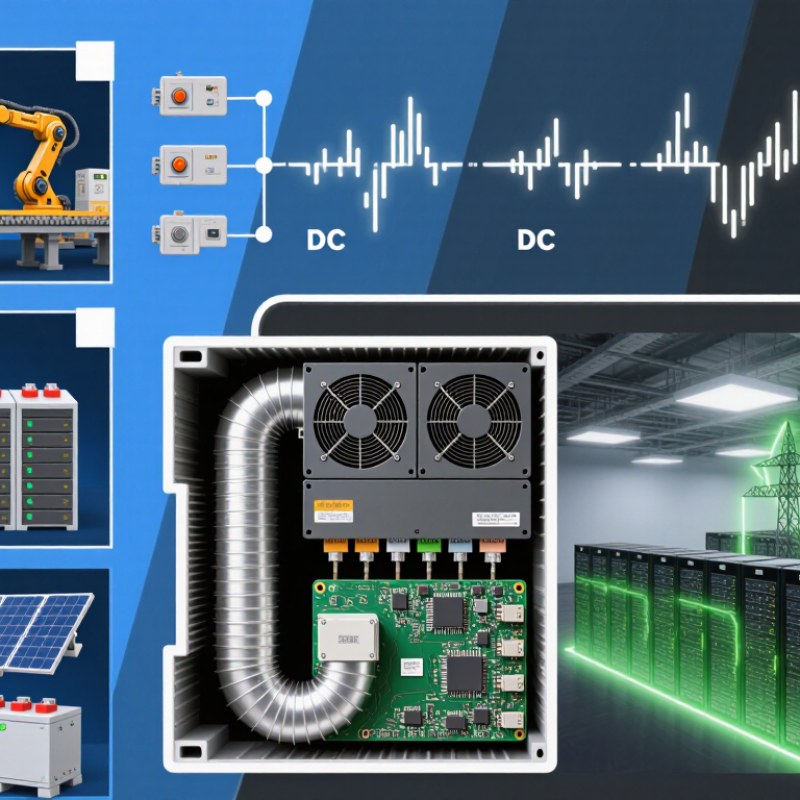
A three-phase industrial DC-AC inverter converts direct current from batteries, solar arrays, or a DC bus into controlled three-phase alternating current. Its three output phases are separated by 120 degrees, creating a steady waveform for motors, pumps, compressors, and industrial equipment. Unlike a basic household inverter, this system manages higher power, changing loads, and demanding operating conditions.
Inside the enclosure, power switches rapidly control the DC voltage through pulse-width modulation. Filters then reduce unwanted electrical distortion before power reaches the load. Control software adjusts output voltage and frequency, while sensors monitor current, temperature, insulation, and faults. A practical commissioning check should include phase balance, grounding, cooling airflow, and response during motor startup. Small wiring errors can create large problems.
Industrial selection requires more than matching kilowatts. Engineers should check continuous and peak ratings, DC input range, overload duration, efficiency, enclosure protection, harmonic limits, and maintenance access. A dusty factory floor is not the same as a clean control room. Real installations are less tidy than diagrams. A higher rating does not automatically mean better performance; oversized equipment may operate inefficiently at light loads. In field evaluation, the difficult detail is often thermal management, not the nameplate rating. Ambient heat, blocked filters, and frequent cycling can shorten service life. The design may look correct on paper, yet need revision after measurements.
A three-phase industrial DC-AC inverter converts direct-current power from sources such as batteries, photovoltaic arrays, fuel cells, or DC buses into balanced three-phase alternating-current power for motors, grids, and industrial equipment. The specifications below represent common engineering ranges and selection characteristics rather than data from a specific manufacturer or brand.
| Inverter Type | Typical DC Input Range | Typical AC Output | Common Power Range | Typical Switching Device | Typical Efficiency | Primary Industrial Applications | Main Advantages | Important Limitations |
|---|---|---|---|---|---|---|---|---|
| Three-Phase Two-Level Inverter | 48–1,500 V DC, depending on system design | Three-phase AC, commonly 200–690 V line-to-line | 1–500 kW | Silicon IGBT or silicon-carbide MOSFET | Approximately 95–98% | Motor drives, pumps, fans, compressors, conveyor systems, and small industrial energy-storage systems | Simple topology, mature control methods, comparatively low cost, and easy maintenance | Higher voltage steps and switching losses than multilevel topologies; may require a larger output filter for demanding power-quality requirements |
| Three-Level Neutral-Point-Clamped Inverter | 600–2,400 V DC | Three-phase AC, commonly 400–1,000 V line-to-line | 250 kW–5 MW | IGBT, silicon-carbide MOSFET, or press-pack power semiconductor modules | Approximately 97–99% | Medium-voltage motor drives, industrial pumps, compressors, test systems, and high-power converters | Lower voltage stress per device, reduced output-voltage distortion, and lower filter requirements than a two-level design | More switches and capacitors, neutral-point voltage balancing requirements, and greater control complexity |
| Three-Level T-Type Inverter | 600–1,500 V DC | Three-phase AC, commonly 400–800 V line-to-line | 50–500 kW | Silicon-carbide MOSFET, IGBT, or hybrid semiconductor configuration | Approximately 97–99% | High-efficiency motor drives, battery energy-storage systems, photovoltaic power conversion, and industrial UPS equipment | High efficiency at partial load, reduced harmonic content, and improved switching performance compared with many two-level designs | Requires careful thermal design, gate-drive coordination, and protection against switching transients |
| Cascaded H-Bridge Multilevel Inverter | Several isolated DC sources; total voltage commonly 1–15 kV DC | Medium-voltage three-phase AC, commonly 2.3–13.8 kV | 1–20 MW | IGBT or other high-power semiconductor modules | Approximately 96–99% | Large motor drives, mining equipment, rolling mills, water-treatment plants, and high-power industrial machinery | High-quality output waveform, modular construction, scalable voltage rating, and lower device voltage stress | Needs multiple isolated DC sources or front-end modules; system balancing, synchronization, and maintenance are more demanding |
| Modular Multilevel Inverter | Several hundred volts to several kilovolts DC, arranged in submodules | Medium- and high-voltage three-phase AC | 1–100+ MW, depending on the system architecture | IGBT, press-pack IGBT, or other high-power semiconductor modules | Approximately 97–99.5% | High-power drives, grid-connected converters, flexible AC transmission, large battery systems, and industrial power-quality equipment | Excellent waveform quality, high scalability, reduced filter size, and strong suitability for high-voltage applications | Large number of submodules, complex capacitor-voltage balancing, advanced controls, and higher installation cost |
| Regenerative Three-Phase Inverter | Typically 400–1,500 V DC, depending on the DC bus | Three-phase AC with bidirectional power flow | 5 kW–5 MW | IGBT, silicon-carbide MOSFET, or active-front-end semiconductor modules | Approximately 95–99% | Elevators, cranes, test benches, centrifuges, machine tools, electric vehicle production, and high-inertia machinery | Returns braking energy to the AC grid or DC bus, reduces braking-resistor losses, and supports four-quadrant motor operation | Requires grid synchronization, suitable protection, harmonic control, and compliance with local interconnection requirements |
| Grid-Forming Battery Inverter | Commonly 400–1,500 V DC battery systems | Three-phase AC, commonly 400–800 V or medium-voltage through a transformer | 30 kW–10+ MW | IGBT or silicon-carbide power modules | Approximately 96–99% | Microgrids, industrial backup power, renewable-energy integration, peak shaving, and weak-grid applications | Can establish voltage and frequency, provide voltage support, and operate with limited or absent grid strength | Requires advanced protection and control coordination; battery safety, thermal management, and state-of-charge control are essential |
| Grid-Following Solar or DC-Bus Inverter | Typically 600–1,500 V DC for modern commercial and utility systems | Three-phase synchronized AC, commonly 400–800 V or medium-voltage through a transformer | 10 kW–5+ MW | IGBT or silicon-carbide MOSFET | Approximately 97–99% | Photovoltaic plants, DC microgrids, industrial DC buses, and renewable-energy power conversion | High conversion efficiency, power-factor control, reactive-power support, and straightforward grid-connected operation | Needs an existing AC voltage reference and may be unsuitable for weak-grid or islanded operation without grid-forming support |
Selection note: The appropriate inverter depends on DC voltage, required power, AC voltage, motor or grid behavior, harmonic limits, bidirectional-power requirements, cooling method, overload duration, enclosure rating, isolation requirements, and applicable electrical standards. Efficiency values are typical design ranges and vary with load, switching frequency, temperature, topology, and operating conditions.
It converts DC electricity from batteries, solar arrays, or a DC bus into controlled three-phase AC power. The phases are 120 degrees apart. This supports motors, pumps, compressors, and production equipment.
Power switches rapidly connect and disconnect the DC voltage. Pulse-width modulation shapes three alternating waveforms. A DC-link capacitor smooths voltage changes. Filters reduce unwanted distortion before power reaches the equipment.
Balanced phases help motors run smoothly and reduce unnecessary heating. An unbalanced phase can trigger reduced output or shutdown. Check phase rotation before machinery starts. Small wiring mistakes matter.
Check motor voltage, current, starting demand, duty cycle, and overload duration. Also confirm continuous and peak ratings separately. A 45-kilowatt motor may draw several times its rated current during acceleration. Nameplate power alone is not enough.
Dust, moisture, vibration, and high ambient temperature can shorten service life. Blocked filters restrict cooling airflow. Metal dust may damage equipment near ventilation openings. A clean control room is different.
No. An oversized inverter may operate inefficiently during light loads. It can also increase purchase and maintenance costs. However, future load growth may justify additional capacity. The decision needs measurements, not guesswork.
Test grounding, insulation, phase balance, cooling airflow, and motor-starting response. Measure harmonic distortion, heat buildup, and sudden load changes. Inspect cable routes near noisy electrical equipment. Paper designs can fail in the field.
Accessible terminals, replaceable fans, fault records, clear alarms, and remote diagnostics can help. Inspect cooling fans and terminals at planned intervals. Review event logs for rising current or repeated faults. Monitoring is not magic.
Three-phase industrial DC-AC inverters convert direct current from sources such as batteries, solar arrays, or DC power systems into stable three-phase alternating current for industrial equipment. They use switching circuits, control systems, and filtering components to produce synchronized output with the required voltage, frequency, and waveform. Their performance is commonly evaluated through power rating, conversion efficiency, output stability, overload capacity, protection functions, cooling design, operating environment, and monitoring capabilities.
Major inverter types include grid-connected, off-grid, backup, regenerative, and variable-frequency solutions, each suited to different industrial applications such as motor control, renewable energy integration, emergency power, and automated production systems. When selecting the best 3-Phase Industrial DC-AC Inverters for 2026 projects, engineers should consider load characteristics, peak demand, input voltage range, expansion plans, installation conditions, maintenance requirements, safety features, and total lifecycle cost. A well-matched inverter can improve energy reliability, operational efficiency, and long-term system flexibility.